


I spend a lot of time looking at how job seekers use AI. Not because I’m judging them for it. I use AI constantly, I’ve built workflows around it, I’ve written a book on it. But there’s a pattern I keep seeing everywhere, and the Reddit post circulating right now is a clean example.
Someone with a username like “chatgptipz” posts a prompt. Two thousand people upvote it. The headline promises Google, Meta, and Microsoft approval. And thousands of job seekers copy it into ChatGPT, paste in their resumes, and wait for something to happen, trusting that this anonymous person understood something about hiring that they don’t.
That trust is the problem. Not the AI. The trust.
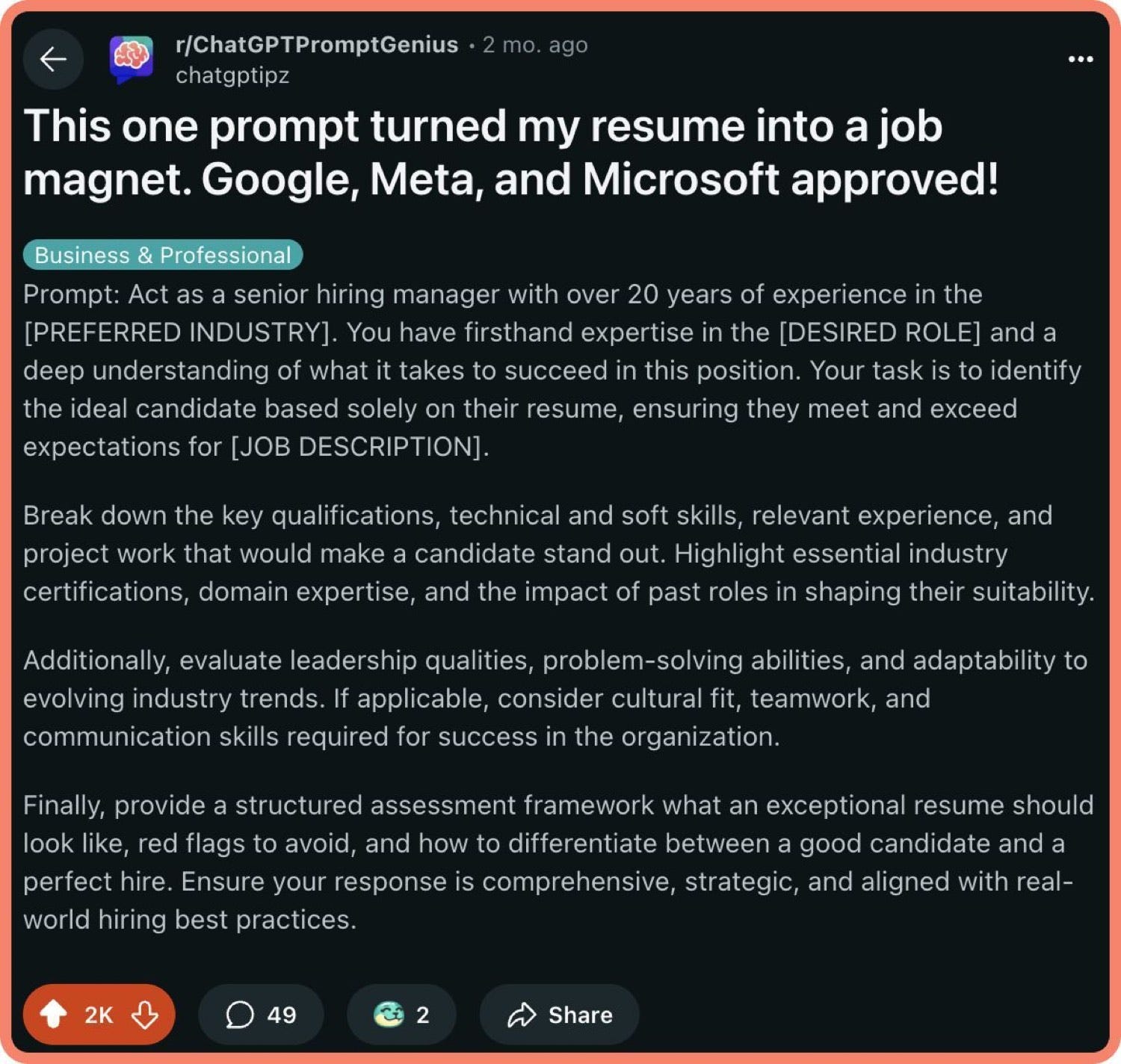
Because here’s what nobody says out loud in these comment threads: the person who wrote that prompt has never seen your resume. Has no idea what role you’re targeting. Doesn’t know if you’re a mid-career engineer changing industries or a recent grad applying to your first real job. The prompt was written to perform well in a Reddit post, not to perform well in a hiring process. Those are different optimization targets, and they produce different results.
2,000 upvotes does not mean it works
What upvotes actually measure? It measures how appealing something sounds to people who haven’t tested it yet. Resonance, not results. “This one prompt turned my resume into a job magnet” is a great headline for engagement. It is a terrible method for evaluating whether a prompt produces better outcomes inside a real hiring process run by real people with inconsistent criteria and different priorities on different days.
Nobody posting that prompt ran a controlled test. Nobody tracked their application-to-interview rate before and after using it. Nobody verified that the “Google, Meta, and Microsoft approved” claim reflects anything beyond the fact that the post author liked how the output sounded. The post exists to collect upvotes, and upvotes reward confidence and novelty, not accuracy. A prompt that says “this might help a little in some cases depending on how you use it” gets three upvotes. A prompt promising tech giants is a different story.
Content that performs on Reddit and LinkedIn is content that makes people feel like they just discovered something. That feeling is addictive. It’s also not the same as discovery.
There’s also something specific happening with job search content that makes this worse. People in job searches are often desperate or close to it. Desperation makes you receptive to promises. It makes you less likely to ask “but does this actually work?” and more likely to ask “when do I start?” The viral prompt exploits that dynamic, probably without meaning to.
What the prompt is actually doing to your application
Look at what that specific prompt asks the model to do. It tells ChatGPT to act as “a senior hiring manager with over 20 years of experience” and produce a structured assessment of what an ideal candidate looks like. It asks for analysis of leadership qualities, cultural fit, certifications, and a breakdown separating a good candidate from a perfect hire. Then, when people ask it to rewrite their resume based on that output, the model produces a document optimized toward a fictional standard it just invented.
The model has no idea what company you’re applying to. No idea what the hiring manager had an argument with their team about last Tuesday that’s shaping what they’re prioritizing in this search. No idea that the last person in this role quit because of a conflict with a specific colleague, and that “collaborative” is now a loaded word in every resume they review. Real hiring is full of that kind of noise, and the model doesn’t have access to any of it.
I’ve read enough AI-assisted resumes to recognize the pattern in about ten seconds: “Results-driven professional with a proven track record of driving synergistic initiatives across cross-functional teams.” Bullets starting with “spearheaded” and “orchestrated.” A summary paragraph that could have been generated for any of the 400 people applying to the same role, which it probably was.
There’s real data behind this, not just my anecdotal read. A 2024 survey found that roughly 49% of hiring managers report auto-dismissing resumes they suspect are AI-generated. Other surveys put outright rejection rates above 60% when content reads as robotic or impersonal. And those numbers are from before the current surge in AI-assisted applications, so the pattern-recognition among recruiters has only gotten sharper since.
The MIT Sloan1 study that actually did show a benefit from AI assistance (around 8% higher hire likelihood on a large freelancing platform) was specifically measuring something much more modest: using AI for spelling, grammar, and clarity improvements on otherwise human-written content. Not full rewrites. Not generation. Editing. The people using the viral prompt aren’t doing the thing that worked. They’re doing the louder, more dramatic version that produces the opposite result.
Ready to transform your recruiting skills? My new LinkedIn Learning course, “The Future of Recruiting: Becoming a Talent Advisor,” is now live! Go beyond theory with an AI-powered Role Play feature, where you can practice your new skills in realistic, interactive conversation simulations.

The accountability gap
The person who posted that prompt has no stake in your outcome. None. If you use it and don’t get a single interview, they never find out. There’s no feedback loop. They posted it, it got upvoted, and they moved on to the next post. They’re almost certainly not a recruiter.
They’re probably not someone who just successfully navigated a difficult job search. They may have spent 20 minutes with the prompt, liked how the output looked on screen, and decided that was enough.
I’ve been a recruiter and a hiring manager. I’ve reviewed thousands of resumes across multiple industries and seniority levels. I’ve also written about AI and job searching publicly for years, made claims about what would work, watched some of those claims fall apart, and had to say so in public. That history changes how I think about advice-giving. My credibility is attached to my claims in a way that an anonymous username’s isn’t.
An anonymous Reddit username has no reputational cost for being wrong. The post exists. People share it. If it doesn’t work for them, they blame their resume, or their experience, or the job market. They don’t post a follow-up saying “that prompt gave me zero interviews.” The failure is invisible. The upvotes are permanent.
This is different from being generally skeptical of free advice. There are people giving genuinely useful job search guidance at no cost, and I try to be one of them. The difference is traceability. Can you find the person’s track record? Do they explain why something works, not just assert that it does? Have they been wrong about something and acknowledged it publicly? Do they have any professional background that would make their take on hiring actually meaningful?
If the answer to most of those is no, you’re looking at content that was optimized for distribution. Not for the thing you actually need.
What good prompting actually looks like
I’ll tell you what produces better results. It’s less exciting than a “job magnet,” and it requires more from you, which is probably why it doesn’t go viral.
Don’t ask AI to rewrite your resume. Ask it to interrogate the job description. Paste in the posting and ask: what are the two or three things this company seems most worried about not finding in candidates? What would someone in this role need to have done in their first 90 days to make the hiring manager feel like they didn’t make a mistake? Those are specific, bounded questions that produce usable output. They help you figure out what to emphasize. They don’t invent experience you don’t have.
Also, ask the AI to research this company online!
Then write your own bullets. Actually sit down and write them. Use AI to make them clearer, sharper, or better structured. Don’t ask it to make them sound more impressive, because “more impressive” is how you get “orchestrated cross-functional initiatives to drive alignment across key stakeholder groups.” “Clearer” is how you get “reduced time to generate the weekly pipeline report from three days to four hours by rebuilding the process in Python, which freed up half a day per week for the whole ops team.” Those don’t read the same to a recruiter, and one of them actually tells me something about you.
I’ll admit that I also want to hand the whole task to the model. It’s faster. The output looks polished on screen. It’s easy to tell yourself it’s good enough when you’re trying to get through ten applications in a week. So I understand completely why someone under job search pressure reaches for the shortcut.
But the shortcut costs something. Your resume starts reading like everyone else’s resume, because everyone else is using the same shortcut from the same viral post. And when a recruiter has seen that same structure, those same verbs, that same summary paragraph format four hundred times in two weeks, yours disappears into the pile with the rest.
Should you trust AI prompts?
Always check the author’s credentials first, or only use prompts that explain their reasoning, or look for evidence that the person has actual hiring experience.
Those are reasonable filters. They help. But I don’t have a clean rule, and I’m not sure one exists. Some prompts from credentialed people are useless. Some prompts from random accounts contain one genuinely useful idea buried in bad framing. The credential doesn’t guarantee anything, and the lack of one doesn’t automatically disqualify the idea.
What I keep coming back to is simpler than a rule: if you can’t evaluate why a prompt would work, you’re not in a position to use it well. Understanding the reasoning behind a prompt is what lets you adapt it to your situation, catch when the output has gone wrong before you submit it, and decide how much to actually trust what came back.
A 2,000-upvote prompt gives you a template and a feeling of confidence. That’s it. And in a job search, those aren’t the same as understanding what you’re doing to your application.
Sometimes people get lucky. Someone uses the viral prompt, the output happens to hit the right keywords for that specific role, and they get the interview. That happens. I don’t want to pretend it doesn’t. But luck isn’t a strategy, and the prompt doesn’t know when you’re getting lucky versus when it’s producing output that’s quietly making things worse.
You’re making a high-stakes decision. The source of your strategy deserves more scrutiny than an upvote count.
What’s a prompt you found online that really worked for you, and what made it so effective?
Here is the prompt structure that works (and why each part is there).
I want to give you the actual structure I use, but I’m going to explain the reasoning behind each part, because a prompt you understand is one you can adapt. A prompt you copy blindly puts you back in the same position as the Reddit prompt, just with different words.
Part one: context before role-play
Don’t tell the model to act as a hiring manager. Tell it what’s actually true: “I’m applying for a [role title] at a company [Name of the company that], where they [one sentence on what they do]. The job posting is below. I have [X years] of background in [relevant area], and I’m trying to figure out where my application is likely to fall short.”
That framing matters. When you assign a role-play persona, the model performs the character. It tries to sound like a senior hiring manager, which means it generates the kind of confident, comprehensive language that sounds authoritative on screen but doesn’t reflect how any actual hiring manager thinks through a real resume. When you give factual context, the model has something grounded to work with.
I’ve run this comparison directly, same resume, same job description, once with the “act as a senior hiring manager” framing and once with straightforward context. The role-play version produced a detailed-sounding assessment full of criteria the company hadn’t actually listed. The context version identified two specific gaps between my background and the posting that I hadn’t noticed. One of those was something I could address in a cover letter. The other told me this wasn’t a strong match and saved me an hour of application work.
Part two: ask for gaps, not evaluations
“Evaluate my resume against this job description” produces a paragraph that reads like a performance review. Moderately positive. Vague on specifics. Ends with encouragement. Useless for actually improving anything.
Instead: “Based on this job posting, which two or three qualifications am I most likely to be screened out for, and what do I have in my background that’s the closest match for each one?”
That’s a bounded question with a specific structure. The answer tells you where to focus your editing energy, not just that you’re a “strong candidate with some gaps to address.” I’ve used this with people who had been applying for months with no traction, and in most cases, the gap analysis surfaced something they already knew but hadn’t dealt with directly in their resume.
One thing I’m genuinely uncertain about: I don’t know how well this works across very different industries. My experience is heaviest in tech and software hiring. I’ve seen it help people applying to marketing and operations roles. I don’t know how it translates to, say, legal or healthcare, where the screening criteria are more credential-driven. Use it, but don’t assume my results will match yours exactly.
Part three: rewrite one bullet, not the whole document
Take the weakest bullet on your resume. The one you’ve been avoiding because you know it’s vague and you don’t know how to fix it. Paste it in and say: “This bullet doesn’t actually say what I did or what resulted from it. Before you rewrite it, ask me three questions about what happened.”
Then answer the questions. Actually answer them, with specifics: what the situation was, what you personally did (not the team), what changed as a result and roughly how much. Then ask for a rewrite based on your answers.
This takes longer than “rewrite my whole resume to match this job description.” A single bullet can take 15 minutes this way. But the output is yours. It contains things that are actually true about your experience. It doesn’t sound like it was generated by someone who’s never met you, because it wasn’t, not really. You supplied the substance. The model just shaped it.
A hiring manager I spoke with last year, after reviewing candidates for a senior product role at a mid-sized B2B company, described the difference between AI-generated bullets and human-edited ones. His words were roughly: “The AI ones are impressive. Every single one. That’s the problem. Real people have one or two great bullets and three mediocre ones. The uniformly impressive resume makes me suspicious.” He’d started looking for the uneven ones as a positive signal.
I can’t generalize that to every hiring manager. Some would probably feel the opposite. But it stuck with me, because it’s exactly backward from what most job search advice assumes: that more polish is always better.
Part four: the read-aloud test
Before you submit anything AI touched, read it out loud. Not to yourself silently. Actually out loud, in a normal speaking voice. If you’d feel ridiculous saying “I spearheaded the orchestration of cross-functional alignment initiatives” in a job interview, it shouldn’t be on your resume. This filter catches more AI-generated noise than any detection tool I’ve tried, costs nothing, and takes about three minutes per page.
The underlying logic: a resume is a preview of how you think and communicate. If the words on it don’t sound like you, the interview will feel like a mismatch to both sides, even if you get through the door. The goal isn’t to pass the AI detector. It’s to sound like a real person who can do real work, because that’s what you are.
That’s probably the most important sentence in this whole section, and I realize it sounds obvious. But the number of applications I see that don’t meet that bar suggests it isn’t as obvious as it should be.
MIT Sloan School of Management, 2023. The study tracked applications across tens of thousands of submissions on a professional freelancing platform over several months.