


Before you keep reading, take the resume test first. Look at the resumes. Guess which ones were written by AI and which ones were written by a human. Don’t overthink it. Don’t read this article first and then pretend you would have known. See if you can spot the AI-written resume.
If you already took the test, thank you. You helped prove something I’ve suspected for a while: most people can’t spot an AI-generated resume. They are spotting bad resumes, obvious punctuation habits, and the same polished nonsense we’ve been seeing in resumes for years.
The funny part is that people sound so certain about it.
I’ve seen recruiters, hiring managers, and others post on LinkedIn saying they can “immediately” tell when a resume was written by AI. I’ve seen hiring managers talk about rejecting candidates because the resume “felt AI.” I’ve seen people treat this like a badge of honor, as if turning someone down for using a tool somehow proves they have standards.
That’s a strange position in 2026. The same companies asking candidates to work more efficiently are adding AI tools to sourcing, screening, writing job descriptions, ranking applicants, and summarizing interviews. Then some of the people inside those companies act surprised when candidates use AI to write a resume.
I don’t think the problem is AI. I think the problem is that many resumes are vague, polished, and empty. AI just makes that easier to produce at scale.
The real issue is that some recruiters, hiring managers, and readers distrust resumes that look AI-generated. For example, if a resume overuses certain punctuation or patterns they connect with AI, they may assume the candidate is cutting corners or being dishonest.
I originally posted this article on LinkedIn, but I thought it was worth sharing here too.
My Test Was Rigged, But Not How You Think
I could have made this test hard. I have enough experience with AI outputs to know what makes a resume look polished and human versus what makes it look generated. I know the tells that aren’t just em dashes, the way AI structures bullet points, the gravitational pull toward certain word clusters, the way it writes experience as capability statements rather than outcomes.
I didn’t use any of that knowledge.
I asked a friend to send me the prompt he uses. It was the kind of prompt that circulates on LinkedIn, one or two sentences, posted by someone who has never actually hired anyone, getting thousands of likes because it’s simple and confident and wrong. I used that “Rewrite this resume...” type of prompt for this test.
Why? Because many people are doing exactly that.
I added my LinkedIn profile as the source material to make it real, so no John Smith or John Doe. I asked the AI to produce eight resume versions, different styles, different layouts. I told it to make the first two obviously AI, with em dashes and the kind of language people associate with generative text. For versions three through eight, I just removed the em dashes and removed my surname from the overview. That was the extent of my editing.
I want to be clear about what I didn’t do: I didn’t run multiple prompts. I didn’t iterate on outputs. I didn’t try to make the later versions convincingly human. If you think the test feels too easy, that’s the point.
The reason I used all eight AI versions instead of mixing in a genuine human resume is that I wanted to see something specific. When people don’t know the baseline, they calibrate against the most obvious examples. Versions one and two become the mental model for “what AI looks like.” Everything else gets compared to those two. If three through eight look different from one and two, people call them human. The em dash becomes the whole theory.
The result was messy. Good.
The point was not “can people detect AI under lab conditions?” The point was: when people don’t know everything is AI, what do they decide is AI?
So yes, people can spot the lazy version. They can spot the loud smell of AI. The first two resumes basically walked into the room wearing a name tag.
But once the obvious signals disappeared, most people were guessing.
A few people DMed me during the test and said they needed the job description to judge whether the resume was tailored. I left the JD out on purpose.
A job description would add another variable people could hide behind. They might say, “This looks AI because it matches the JD too closely,” or “This looks human because it doesn’t feel tailored enough.” But that’s not detecting AI. That’s judging keyword matching, tailoring, and sometimes plain old resume stuffing.
If you need the JD to decide whether a resume is AI-written, you’re probably not detecting AI. You’re checking whether the resume was shaped around a specific posting. And many candidates don’t use AI that way.
A lot of people use AI to create a general resume first. No JD. No tailoring. Just “make this sound better,” which is exactly how many of those viral prompts are used. There’s also a bigger question here: should every resume be tailored to every single role?
Some recruiters say they expect tailored resumes. Career gurus say candidates must tailor every application. That sounds nice until you remember how job search works in real life. People are applying while working full-time, taking care of families, dealing with rejection, or trying to stay sane after months on the market.
Who has time to tailor a resume properly for every role? AI does. And that’s partly why we’re here.
My advice is more practical: don’t tailor your resume for every single job. Tailor it for groups of similar roles. Have one strong version for the type of role you actually want, then adjust only the parts that matter when the role is worth the effort. That’s a much better use of time than turning every application into a custom writing project.
Recruiters Guessed Worse Than Job Seekers
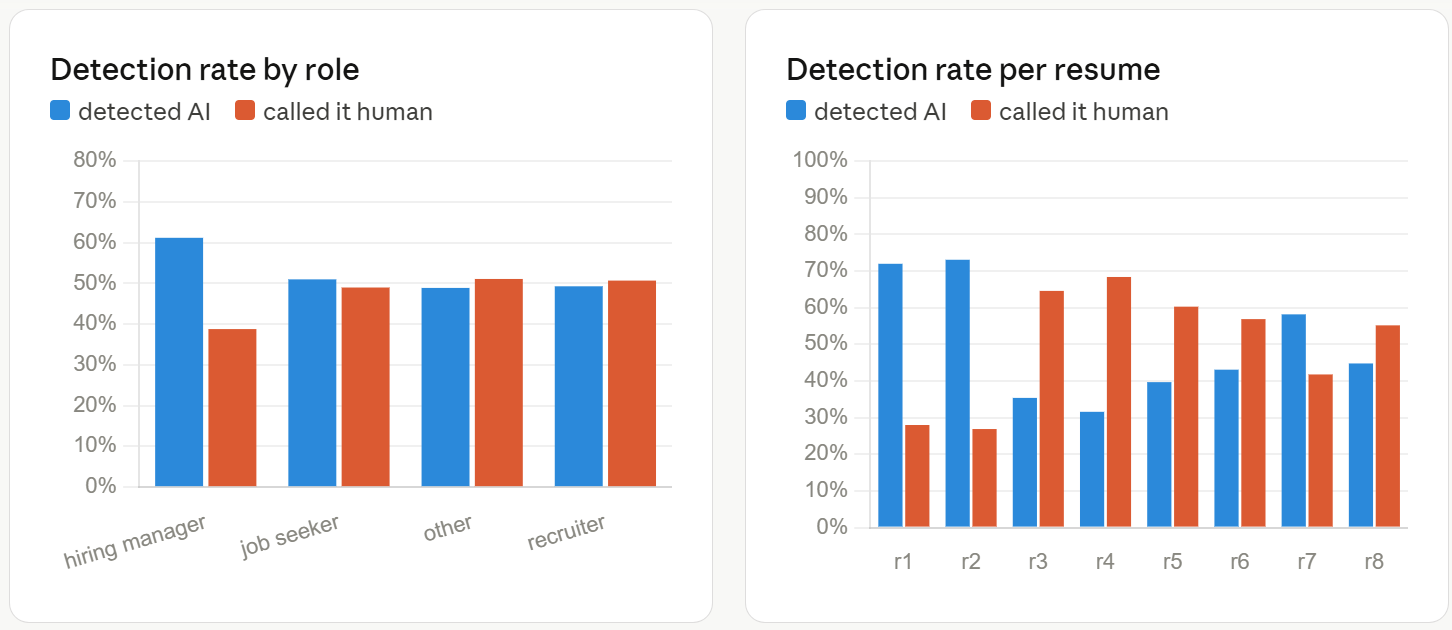
Across all answers from 1,072 people, the overall correct rate was 50.4%. That is statistically indistinguishable from flipping a coin. Every resume was AI, but people called “human” 49.6% of the time.
Some AI resumes “felt human,” others didn’t. This is the most interesting finding in the dataset. Four of the eight resumes fooled the majority of viewers:
r4 fooled 68% of people (only 32% spotted it as AI)
r3 fooled 65%
r5 fooled 60%
r6 fooled 57%
Meanwhile, resumes r1 and r2 were correctly flagged 72-73% of the time. This was intentional, as I kept em dashes in those resumes, a common sign of AI-generated content these days.
Confidence was inversely useful. People who self-rated as “high confidence” averaged 58.8% correct. “Medium confidence” averaged 48.0%, which is below chance. The biggest group was medium-confidence, and they were essentially guessing wrong slightly more often than right.
Role didn’t help. Recruiters scored 49.3%. Job seekers 51.0%. The “other” bucket 48.9%. Hiring managers technically scored highest at 61.2%, but there were only a small number of people in this group, so treat it as noise rather than a real signal.
Only 2.3% of all people were able to guess that all resumes are AI-generated. That percentage is below the typical margin of error for studies like this.
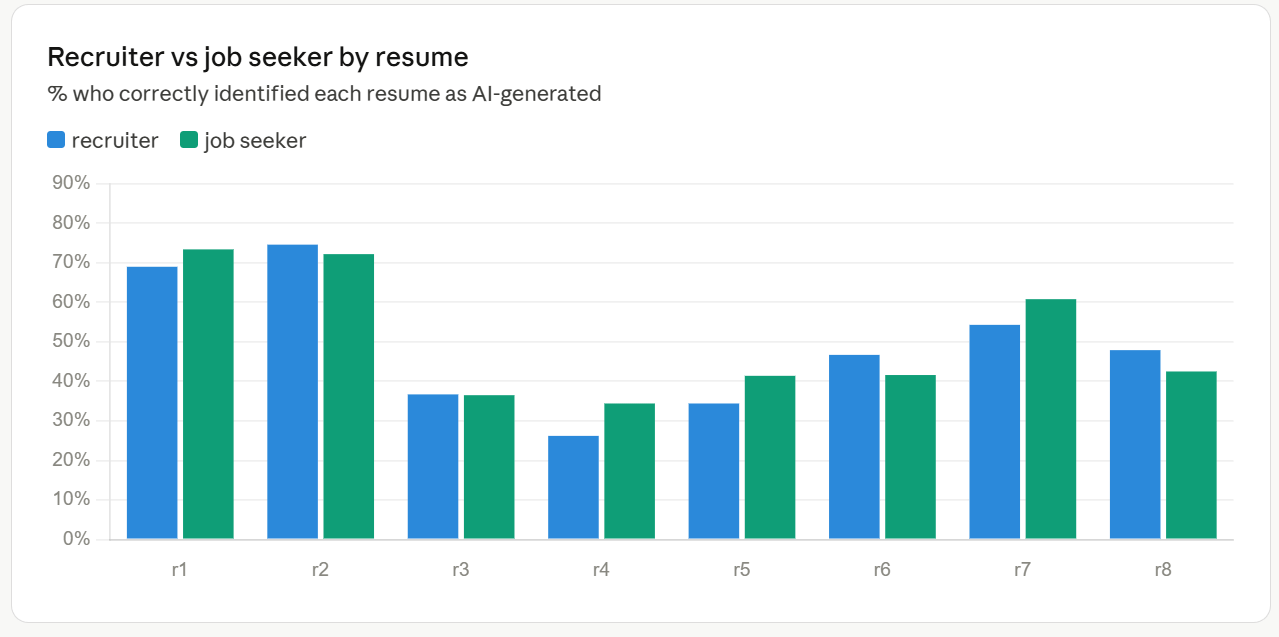
Recruiters score almost the same as job seekers, that’s uncomfortable, because recruiters are the group most likely to claim daily resume review gives them an eye for this. I say this as someone who has reviewed more resumes than I can count. Experience helps you spot mismatch, inflated claims, missing context, and strange career moves. It does not give you magic vision.
This reminded me of a Friday afternoon two months ago when when I found an old version of my resume from around 2010. The formatting was ugly. The file name was worse. I’m pretty sure it had “final final” in it, which is never a good sign. But luckily it was only a working version.
And there it was, the old leadership verb people now mock as an AI tell, the magic word “spearheaded.” Back then, nobody blamed AI for it. We blamed resume templates, career coaches, and people copying phrases from each other. Same disease. New scapegoat.
That story proves very little, of course. My old resume is one document, and I have seen candidates use AI in ways that made their resumes worse. Still, it made me less patient with the current panic. We’ve been reading stiff, inflated resume language for decades.
AI didn’t invent it. It industrialized it.
There’s research outside resumes that points in the same direction. OpenAI shut down its own AI text classifier in July 2023 because of a low accuracy rate. In its own evaluation, the classifier correctly identified only 26% of AI-written text as likely AI-written and incorrectly labeled 9% of human-written text as AI-written.
That does not mean detection is impossible in every setting. It means people should be careful before turning a hunch into a rejection reason.
A 2025 open-access study with 63 university lecturers found they recognized only about half of AI-generated academic texts. The study also found that higher-level AI-generated texts became harder to distinguish from human ones. Different field, same warning sign.
And my test was not academic writing. It was resumes. Resumes are already unnatural.
Nobody talks like a resume. Nobody says over coffee, “I managed cross-functional delivery across distributed teams while driving measurable improvement in operational efficiency.” If someone did, you’d check if they were okay.
That’s part of why detection is so weak here. The baseline human document already sounds fake.
The Em Dash Obsession is Lazy Hiring
People have become obsessed with small tells. The em dash. Certain verbs. Certain adjectives. Smooth bullets. Too much symmetry. Too many claims without numbers. A summary that sounds like it came from a career page.
Some of those signals are useful. I remove some of them from my own writing because they’re overused by AI. I get it.
But treating one punctuation mark as evidence of deception is poor hiring.
These are some of the most common tells that make people assume a resume was written with AI: Em dash, this is probably the main one right now, Spearheaded, Pioneered, Helmed, Orchestrated / Leveraged / Synergized, Streamlined, Delve (or “delve into”), Foster / Foster(ed), Navigate / Navigating, Revolutionize / Transformative.
And then there are the phrases that now carry the same strange AI smell: Proven track record, At the intersection of, Actionable insights, Cross-functional (initiatives / collaboration), Fast-paced environment, Indelible mark / Testament to, Seamless / Synergistic, In summary / Moreover / Additionally / Thus / Hence, Provide a valuable insight, Left an indelible mark, A stark reminder.
The funny part is that many of these words were in resumes long before ChatGPT existed. I saw “spearheaded” 15 years ago. I found it in my own old resume from 2010. Back then, nobody called it AI. It was just resume language. Now these words have a strange cover-letter vibe.
They don’t automatically prove AI was used. But they do make the resume feel polished in the worst way: generic, inflated, and slightly detached from how people actually talk about their work.
Candidates have been copying resume language from templates since before LinkedIn was useful. Before that, they copied from books. Before that, probably from someone’s cousin who “knew HR.” Every generation has had its resume folklore.
Now the folklore has prompts.
There is no magic prompt that makes a resume “100% fit” a role. I wish job seekers would stop believing that. Those prompts are the modern version of “beat the ATS with white keywords.” They sound clever, they spread fast, and they hurt the exact people who are desperate enough to try them.
The cost is not only money, though some people pay for this stuff.
The bigger cost is time. A candidate spends two hours polishing a resume into a smooth, role-shaped object and never stops to ask whether the claims are true, specific, or useful. Then they get an interview and freeze when someone asks about a skill AI added because it appeared in the job description.
I coached a candidate recently who had done exactly that. Saturday morning, too early, coffee gone cold on my desk, and I was already annoyed because Windows decided it needed to update something in the background. We walked through his resume line by line. I asked about one skill. He paused. Then he told me the AI tool suggested adding it because it matched the role.
He had used that version for around 20 applications. He got two interviews. Both went badly when the interviewer asked about the same skill. His situation was not rare, but it also wasn’t some moral failure. He was tired. He had been rejected for months. Someone online told him this was how you compete now.
That’s the part hiring teams miss when they get too excited about catching AI. Some candidates use AI because they’re lazy. Some use it because they were misled. Some use it because they’re not native speakers and want their experience to sound professional. Some use it because the job market has made them feel like a normal resume is not enough.
Rejecting them because you think you spotted AI does not make you a better recruiter. It may just mean you rejected someone who got bad advice.
Now, there is one hard line for me: the resume must be truthful. If AI adds a skill, project, certification, scope, tool, or metric that the person cannot defend, that’s on the candidate. You don’t get to outsource honesty to a chatbot.
But if the content is accurate, I don’t care whether the first draft came from AI, a friend, a resume writer, or a tired candidate at midnight.
I care whether I can understand what the person has actually done.
“But Jan, our AI tool can spot AI-generated resumes in seconds.” I can already hear the next sales pitch landing in my DMs. My answer is simple: in a world where almost every company is using AI somewhere in hiring, punishing candidates for using AI for their resume sounds strange.
And before you try to sell me another AI detector, you’ll need to answer one more thing: is your tool actually better than a careful recruiter asking specific follow-up questions, or is it just faster at being wrong?
AI Screening Has Its Own Resume Bias
Some people will say, “Fine, humans are bad at detecting AI resumes. Let AI tools handle it.”
That sounds cleaner than it is.
A recent paper, “AI Self-preferencing in Algorithmic Hiring,” looked at what happens when LLMs evaluate resumes. The researchers found that models consistently preferred resumes generated by themselves over human-written versions, even when the underlying candidate information was identical and content quality was controlled.
Read that again slowly.
The model was not simply picking the better candidate. It was favoring text that resembled its own output.
The paper reports self-preference bias ranging from 68% to 88% across tested models. In simulations across 24 occupations, candidates using the same LLM as the evaluator were 23% to 60% more likely to be shortlisted than equally qualified applicants with human-written resumes. The largest disadvantages appeared in business-related roles such as sales and accounting.
That should make hiring teams uncomfortable. Because this creates a weird new advantage. Not better experience. Not better judgment. Not stronger results.
Tool matching.
Use the same machine style as the evaluator and you may move forward. Use your own words and you may lose.
I’m not sure how much this applies to every real hiring system today. Majority of employers still don’t use LLMs as final resume screeners, and many tools are layered inside older systems with human review in the middle. The evidence is early, and the market is messy.
But the direction is not hard to see.
If companies use AI to evaluate AI-written resumes, they may reward candidates who sound most like the machine. That’s not fairness. That’s a copy of a copy being rewarded for looking familiar.
There’s another recent line of work that worries me too. A 2026 paper on LLM-generated resume summaries found that factual content could remain mostly stable while evaluative wording changed based on race-gender name signals, especially in the extremes of the distribution. The study analyzed nearly one million resume summaries.
So when someone says AI screening is more objective because it has no feelings, remember this: a system does not need feelings to produce unfair outcomes. It only needs patterns.
And hiring is full of patterns we already struggle to control. Or patterns that are full of biased data.
What I’d Tell Candidates Now
Use AI. Just don’t let AI invent you!
That’s the boring advice, but it’s the advice I keep coming back to.
Use AI to clean structure. Use it to find unclear bullets. Use it to compare your resume against a job description and ask, “What is missing that I can honestly support?” Use it to rewrite a clumsy sentence if English isn’t your first language. Use it to shorten a summary that sounds like it was written for a brochure.
Then check every claim! Every skill. Every number. Every tool. Every title. Every business result. Every word that makes you sound more senior than you are.
This is what most people do not do. They enjoy the AI output because it looks finished. It has rhythm. It has bullets. It sounds employable. Reviewing it feels slower than generating it, and slower feels wrong when you’ve been unemployed for months.
But that review is the work.
I’d rather see a slightly awkward resume with real detail than a glossy one full of claims that collapse in the first interview.
For example, don’t write that you “improved recruitment efficiency.” Say what changed. Time to shortlist went from 12 days to 7. Our brains love numbers; that’s why the XYZ formula is so powerful. You do not need big numbers, even a small one is fine. Real is better than grand.
And if you don’t have numbers, give context.
What was broken? What did you do? Who cared? What changed after?
That’s where AI often struggles unless you feed it the real material. It can polish weak input. It can’t magically know the messy parts of your job.
I also want candidates to stop believing every fast rejection is AI. Many rejections within minutes come from knockout questions. Work authorization. Location. Salary mismatch. Required certification. Shift availability. You answered the question, the system applied the rule, and the rejection email went out.
That’s painful. But it’s not always a robot reading your resume and judging your punctuation or missing some keywords.
There’s a whole separate conversation about badly designed knockout questions and how companies accidentally reject good people. I’m not getting into that here, partly because it makes me more irritated than this topic.
For recruiters and hiring managers, I’d say something even simpler: stop trying to detect AI as a primary filter.
Detect evidence.
Ask better follow-up questions. Look for specificity. Compare claims against career history. Probe the parts that sound too polished. If someone says they led a migration, ask what broke. If someone says they used a tool, ask what they used it for last week. If a resume claims commercial impact, ask who measured it.
That will tell you more than punctuation. It also takes more effort. The current job market is terrible, and AI auto-apply tools killed the signal. Now recruiters are drowning in applications, and trust in hiring is disappearing.
There’s the downside. You don’t get the cheap satisfaction of saying, “AI resume, rejected.” You have to read with more care. You have to accept that some candidates with AI-polished resumes are good, and some candidates with human-written resumes are bad. Messy, annoying, normal hiring.
My test didn’t prove humans can never detect AI resumes.
It proved something smaller and more useful: when the obvious signs are removed, most people are not nearly as good as they think.
So I’ll keep telling candidates to use AI carefully, and I’ll keep telling recruiters, hiring managers, and others to stop acting like a punctuation mark is a lie detector.
Here are the main findings
The headline: people cannot detect AI resumes. The overall detection rate was 50.4%, which is essentially a coin flip. If you handed someone a coin and asked them to guess, they would perform the same.
Recruiters are not better at this than anyone else. The group you would expect to perform best, the professionals who review resumes daily, came in at 49.3%. Hiring managers scored highest at 61.2%, but with only 42 people that is a very small sample. Job seekers outperformed recruiters at 51.0%.
Confidence is broken. People who rated themselves “high confidence” got it right 58.8% of the time and answered in 14 seconds. People who said “medium confidence” scored 48.0% and took 16.9 seconds. The extra deliberation made them worse, not better. Feeling certain about your AI detection skills is not correlated with actually having them.
Two resumes are obviously AI. Four are convincingly human. R1 and R2 were correctly flagged by 72-73% of respondents. But R3 and R4 fooled 65-68% of people into calling them human. R5, R6, and R8 sit around 40-60% detection too. So the majority of the resumes tested are essentially invisible to human review.
Recruiters and job seekers agree on which ones fool them. The accuracy pattern across R1 through R8 is nearly identical for both groups. Both were fooled most by R4 (recruiters 26%, job seekers 34%) and both caught R2 most reliably. Whatever signals made R3 and R4 convincing, they worked equally on professionals and non-professionals. The difference is in the resume, not the viewer.


