


You spent six years as a Digital Marketing Manager. That’s what your business cards said. That’s what your LinkedIn says. That’s what you type into the search bar when you’re looking for your next role.
And you’re getting almost nothing back.
Not because you’re underqualified. Not because your experience is weak. Because the market stopped using that phrase while you were busy doing the actual work. Six years of genuine experience, accurately described, and you’re invisible to half the searches that should be finding you.
Tired of seeing job seekers get bad advice on LinkedIn? So am I. That’s why I created Job Search Guide. If you find any of our articles helpful, please consider sharing them with others who might benefit too. Let’s make the job search better, together.
The vocabulary gap nobody warns you about
Someone has genuinely strong experience, updates their resume, writes a decent cover letter, and then applies to 40 jobs over two months and gets four responses. They blame the market. But a lot of the time, the problem is simpler and more fixable than that.
Job titles drift. Fast.
I was on a coaching call a while back, a Tuesday afternoon, I had three other things I was supposed to be reviewing, and this person named Laura had sent me her LinkedIn profile to look at before the call. She had seven years of experience managing marketing programs for B2B SaaS companies. Solid record. I pulled up her target company list and went through their open roles while we talked. Twelve companies.
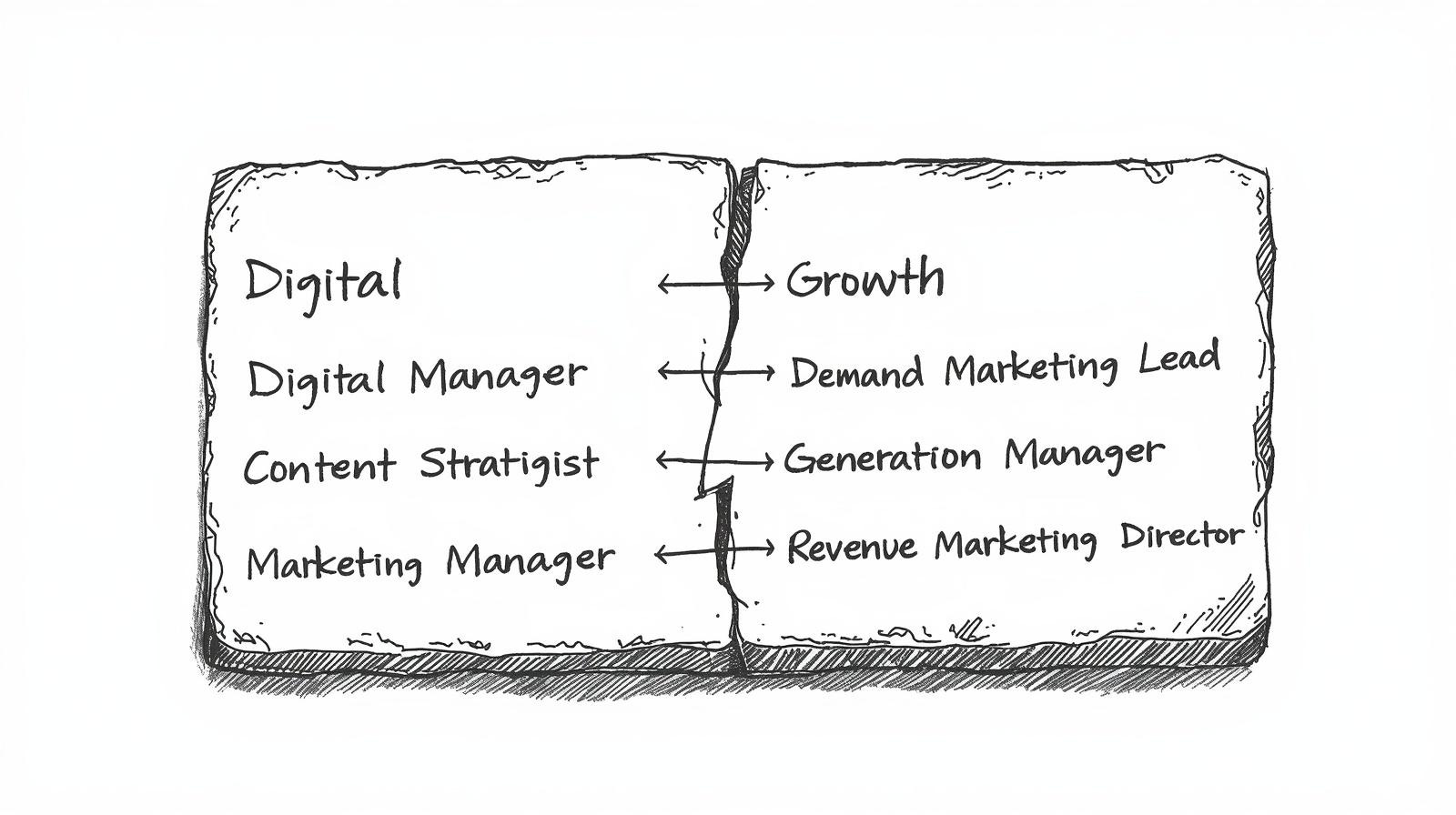
Zero postings with the exact title she’d been using and was searching for. Not because those roles didn’t exist, but because those companies had all moved to “Revenue Marketing Manager,” “Lifecycle Marketing Lead,” or in three cases, “Marketing Program Manager” with a scope that clearly matched her experience. She’d been invisible to searches that should have found her immediately.
That’s not a failure of her resume. It’s a vocabulary problem. And once I showed her the language the market was using, she had it fixed in an afternoon.
“Digital Marketing Manager” is still a real job. Companies still hire for it. But a significant chunk of companies now call that role “Demand Generation Manager” or “Growth Marketing Lead” or, increasingly, “Performance Marketing Director” even for mid-level positions. If you’re searching for “Digital Marketing Manager” on LinkedIn, you’re missing every one of those postings. And if your headline says “Digital Marketing Manager,” the recruiter sourcing for a “Growth Marketing Lead” may not find you even when you’re exactly who they want.
One research study partially explains why this matters more than people expect. A 2018 study from the job market analytics firm Burning Glass (now Lightcast) tracked terminology shifts across 150 million job postings over a decade and found that title language in tech and marketing roles turned over significantly faster than in fields like accounting or nursing. The specific numbers varied by sector, but in marketing specifically, the dominant title vocabulary shifted noticeably roughly every three to four years. I’m not going to pretend I have the original paper in front of me, but the finding has been cited enough in talent analytics circles that I’m confident the direction is right.
The implications are worth sitting with for a moment. Your title isn’t wrong. Your experience isn’t stale. But the words you use to describe both might be.

Why companies stopped using the titles you trained under
Part of this is genuine evolution. The job actually changed. “Digital Marketing Manager” in 2015 meant something different than it does now, and companies creating new roles had to reach for new language to describe the scope. That’s fair.
But a lot of it is something else, and I find it hard to stay fully neutral about it: title inflation and internal hierarchy games. Companies invented “Lead,” “Principal,” and “Staff” designations partly to retain people without promoting them. They adopted startup vocabulary to seem more current. HR departments got into naming contests. At some point, “Demand Generation Manager” wasn’t describing a new kind of work. It was describing the same work with a shinier label because the VP of Marketing had read a SaaStr article.
I’ve seen this from the recruiting side for years, and I don’t have a clean explanation for why it accelerated the way it did in the late 2010s. Remote work probably contributed: when you’re not physically in an office, your title is one of the few external signals of where you sit.
Salary transparency initiatives may have helped, too, by creating pressure to differentiate titles when companies couldn’t easily adjust pay. I’m speculating at this point. What I know from direct observation is that the vocabulary drift accelerated, that it varied by function and industry, and that it made candidate profiles harder to match to postings in ways that affected real people’s searches.
This does create a side problem worth acknowledging even though I’m not going to go deep on it here: it becomes genuinely hard for candidates to know which new title represents a real evolution in scope versus which one is a rebrand of a role they’ve done for years. I’ve seen candidates undersell themselves because they assumed “Head of Revenue Marketing” was beyond their experience, when what the company meant was basically what they’d been doing for three years under a different name.
Whether companies should standardize their titles more is a separate argument. Some people think open title systems create flexibility. Some think they create confusion. I don’t have a strong position on it. What I do have a strong position on is that waiting for companies to fix this is not a job search strategy.

Ninety minutes and a spreadsheet
The exercise itself is straightforward, but people skip it because it sounds like homework. It is homework. It takes about 90 minutes the first time and maybe 30 minutes if you refresh it later in your search.
Start by listing 15 to 20 companies you actually want to work for. Not dream companies and not random companies you pulled from a “best places to work” list. Companies where you could genuinely see yourself in the next role. If you don’t have 15 to 20, work with what you have, but try to get to at least 10 to make the data meaningful. Fewer than 10 companies won’t give you enough postings to see patterns. You’ll just see individual preferences rather than market consensus.
Go directly to their career pages. Not LinkedIn, not Indeed. The actual company career pages, because that’s where you’ll see the exact language they chose when they wrote the posting. Job boards sometimes normalize or truncate titles. LinkedIn in particular has a “standardization” feature that flattens submitted titles into its own taxonomy. You want the raw language, not a platform’s cleaned-up version of it. Pull 25 to 30 job postings for roles at your approximate level in your function. You don’t need to be eligible for all of them. You need the language.
Now look at three things in each posting: the title itself, the tools and platforms mentioned in the requirements, and the “what you’ll do” section. Write them down somewhere. A spreadsheet is fine. A Google Doc with a list is fine. The format doesn’t matter. You’re looking for patterns.
A few people I’ve coached prefer to paste everything into a single document and do a word frequency count afterward, which works fine if you’re comfortable with that. Most people I work with just read through and underline. The manual reading actually has an advantage: you start internalizing the language faster because you’re reading it in context rather than counting it. Either approach gets you there.
After 20 or 25 postings, you’ll start seeing the same three or four titles show up repeatedly. You’ll see certain tools mentioned constantly that you haven’t featured prominently in your profile. You’ll see action verbs in the responsibilities section that you haven’t used to describe your own work even though you’ve done exactly that work. That vocabulary is the current market language for your role. Your goal is to learn it and use it.
One thing I should say: this is not about lying. Don’t claim a title you didn’t hold. Don’t say you’ve led demand generation strategy if you’ve never heard the term used in your own work. What you’re doing is translating. You managed paid social campaigns and analyzed attribution data. Some companies call that “demand generation.” If that’s what the 20 postings you studied call it, and it’s accurate to your work, you can say demand generation.
The translation step is where I still see people hesitate, and I get it. There’s a nervousness about claiming language that feels unfamiliar even when it describes something you’ve genuinely done. I’ve coached people through it enough times that I can say with confidence the hesitation is usually worse than the risk, but I also can’t promise you’ll feel comfortable with it immediately. Some of that discomfort is appropriate caution. Some of it is imposter syndrome disguised as precision.
After you build the map from your old terms to the market’s current terms, apply the new language in four places: your LinkedIn headline, your LinkedIn summary, your resume summary, and your job search alert keywords. That last one matters more than people realize. If your alerts are still pulling for “Digital Marketing Manager” and you’ve discovered the market says “Growth Marketing Lead,” you’re getting a partial picture of what’s open.
A practical note: don’t rewrite every bullet on your resume at this stage. That’s a different project and you’ll burn out before you start applying. Update the headline, the summary, and the alerts. That’s enough to start seeing different results.
Where this breaks down
I’ve seen this exercise work well enough that I recommend it to almost everyone early in their search. I’ve also seen it fail, and I should say something about when.
If you’re searching at a very senior level, say VP and above, titles are less searchable and more relationship-driven anyway. The exercise still has value for vocabulary and interview framing, but don’t expect it to dramatically change your inbound sourcing results. Recruiters filling VP roles are usually doing manual research, not keyword searches. The title problem matters most in the IC-to-manager range, roughly where most job seekers actually are.
I’m also genuinely uncertain whether this holds equally well across all geographies. I’ve done most of my work with job seekers targeting North American and Western European markets, where the tech and startup title inflation has been most pronounced. I’ve heard from coaches working in markets where titles are more formal and standardized that the vocabulary drift is less severe. I can’t verify that from my own experience.
And there’s a version of this that I’ve watched backfire: people who overcorrect. They discover the new vocabulary and stuff their profile with every trending title phrase they find, to the point where it reads like a keyword document rather than a person’s actual history.
A recruiter who finds your profile and schedules a call will ask you questions based on what your profile says. If you’ve described yourself in language that doesn’t match how you’d actually talk about your work, that gap shows up fast. Badly, sometimes. I’ve seen candidates get screened out at the phone screen stage after getting past an initial search precisely because the language on their profile had gotten ahead of their fluency in conversation.
The goal isn’t to mirror the market perfectly. It’s to get close enough that the right searches find you, and close enough that the language holds up when someone actually reads your profile.

What to do with what you find
Do the research before you do anything else in your job search. Before you update your resume. Before you reach out to your network. Before you start applying.
The 90 minutes you spend mapping market vocabulary to your own experience will make every other part of the search more effective in a way that’s hard to explain until you’ve done it. Your outreach will feel more natural because you’ll be using the language the person on the other end uses all day. Your interviews will start from a better shared reference point. You’ll spot relevant postings you would have previously scrolled past.
Something I didn’t expect the first few times I walked people through this exercise: it sometimes changes what someone decides to pursue. Reading 30 postings carefully will tell you things about a function or industry that a job title alone doesn’t. You see which companies are investing heavily in a capability. You see which ones still have outdated requirements that suggest they don’t really understand the role. You see salary ranges when they’re listed, and you can start building a realistic picture of what the market looks like right now, not two years ago.
What I can’t promise is that it fixes everything. If the market is genuinely slow in your function, updating your vocabulary doesn’t change that. If you’re targeting a narrow niche, 20 postings might not give you enough signal. And some people do the research and realize the vocabulary gap wasn’t actually their main problem, which is useful to know even if it’s frustrating to discover.
Refresh the exercise every four to six weeks during an active search. Title language doesn’t shift overnight, but it does shift, and a posting you missed in month one might be using language you now know to look for in month two.
There’s probably a version of this for how your industry describes skills rather than just titles, which is a slightly different problem and worth its own attention. I haven’t worked that out as cleanly so I’m not going to tell you I have.
The first part of the article explains the logic and gives you the 90-minute structure. But a lot of people get to the spreadsheet step and stall because they’re not sure what they’re looking for or how to read the patterns once they find them.
What follows is the actual analysis method I use with coaching clients, including a worked example from a real search (details changed) and the specific questions I ask to turn raw posting data into usable language.
