


Many job searches begin with activity that feels productive and creates almost no new information or new leads.
A new resume version, another headline rewrite, twelve applications before lunch. Maybe a paid template because the current CV suddenly looks suspicious after staring at it for two hours.
The work is visible, measurable, easy to count, and it feels like progress even if it’s not. By Friday, you can say you applied to 47 jobs, and within two weeks you can post on LinkedIn about your 300 applications but zero responses.
You may still know almost nothing about whether you are targeting the right companies, whether your salary expectations fit the market, which employers are quietly preparing to hire, or how people with your background are getting into the roles you want.
That is why the first serious task in a job search should often be a review of your existing network.
Start with the people already connected to you on LinkedIn. Former colleagues and recruiters you spoke with before. People who moved into the type of role you are considering. Employees at companies that interest you. A manager you worked with four years ago and have not spoken to since.
Do not begin by asking them to get you a job. Ask them to help you understand what is happening on the market and in their company.
This newsletter issue is sponsored by HeadshotPro: Your headshot speaks before you do. Make it count with HeadshotPro, studio-quality AI headshots in under 30 minutes, no photographer needed. All you need are a few selfies and you’ll have a professional headshot from the comfort of your own home.
HeadshotPro is perfect for individuals and entire teams alike.
Your Network Is Full of Information
LinkedIn makes it very easy to confuse network size with network usefulness.
Having 2,000 first-degree connections may look impressive. Yet a connection you have never spoken to, cannot place, and would feel awkward messaging has limited practical value during a job search. The useful part of a network is the part that can exchange information with you.
The strange part is that some of the best information may come from people who are no longer close to you.
Mark Granovetter’s 1973 paper, “The Strength of Weak Ties,” became famous because of what he found when studying how professional, technical, and managerial workers learned about jobs. In a smaller interview subsample of 54 people who had found work through personal contacts, 16.7% said they saw the relevant contact often. Another 55.6% saw the person occasionally, while 27.8% saw them rarely.
The sample was small, and the study came from a very different labor market, so those percentages should not be treated as a forecast for a LinkedIn job search in 2026. The pattern is still useful: job information often arrives through people outside your closest circle.
A much larger test arrived decades later. Researchers studied several randomized experiments involving LinkedIn’s People You May Know system. More than 20 million people were included over five years, during which about 2 billion new ties and 600,000 new jobs were created. The researchers found causal evidence that weaker ties can increase job mobility, with the strongest effect depending on how tie strength was measured and on the industry. Moderately weak ties were especially useful under one measure, and weak ties appeared more useful in more digital industries.
Those results give you a reason to look beyond the five people you talk to every week.
Let me share a story about a job seeker named Maya (not her real name). She has 1,841 LinkedIn connections and has spent ten days applying for product marketing roles. It's Monday evening; her laptop is at 11% as she looks for a charger during our call, and that stresses her out. She submitted 38 applications that day and 87 last week, and none have led anywhere so far.
Her network review produces something more useful: a former colleague now works at one target company, an old agency recruiter covers her field, and someone she barely knew at a previous employer recently moved into the exact role she wants.
That example proves nothing by itself, and a network review can produce zero useful conversations, especially when the network was built through random connection requests. BUT it can still expose information that another application cannot give you.
There is a second reason to look backward. Research on dormant ties asked 224 executives in four Executive MBA classes to reconnect with people they had not communicated with for at least three years. The completed responses showed that dormant contacts could provide useful knowledge that compared well with the knowledge provided by current contacts. This was research about advice on work projects rather than job searching, so the application here is an inference. Old professional relationships can retain useful context while the people involved have accumulated different information elsewhere.
That old colleague may remember how you work and now know a market that you do not know.

Start With First-Degree Connections
Open your first-degree LinkedIn connections before changing another line of your profile.
You are looking for people with some combination of relevance and relationship. Relevance means they know something useful about the role, company, hiring market, location, or career move you are considering. Relationship means there is enough shared context that a conversation would make sense.
Former colleagues are an obvious place to start because they have evidence about your work. A recruiter you spoke with two years ago can be useful for a different reason: they may know which companies are hiring, which titles have shifted, and whether your target compensation still matches the market. Someone who made your intended career move recently can tell you what changed once they started interviewing.
Do not obsess over seniority. A former teammate may know more about a team’s hiring plans than a vice president who accepted your connection request after a conference.
And do not search only for people who can refer you today.
A referral is an outcome that may come later. Beginning with it changes the conversation. The other person now has to decide whether they know you well enough to attach their name to your application, whether the company has a referral policy, and whether they are comfortable recommending you. You have turned a simple request for information into a request involving reputation.
Ask for perspective first.
A message can be as simple as: “Hi Anna, I’m considering my next move into [role]. Since you know [company, industry, or area], I’d value your view. Would you have 15 minutes for a quick chat next week?”
The request has a reason, a defined topic, and a small time commitment. It also gives Anna an easy way to decline.
Many people will ignore it; others will say they are busy. A few conversations will be pleasant and useless. You may also discover that a person you remember warmly barely remembers you, which is an unpleasant little feature of networking advice that rarely makes it into cheerful career posts.
The discomfort is easy to underestimate. People naturally reach for the contacts who feel safest, which can keep the conversation inside a familiar professional circle. A slightly weaker relationship may expose you to information that has not already travelled through your closest colleagues.
You do not need to message the most awkward person in your database. Comfort simply should not be the ranking system by itself.

Ask for 15 Minutes
A useful networking conversation should help you make a decision.
That sounds obvious until you listen to the questions people ask. “How are things at your company?” can fill 20 minutes without changing anything. “Do you know of any jobs?” often produces a quick no, followed by silence.
Give the conversation a narrow purpose.
Suppose you are considering senior customer success roles at B2B software companies. You speak with a former colleague who joined one of your target employers six months ago. Ask what the company actually values when hiring for that function. Ask whether the title means the same thing there as it did at your previous company. Ask what surprised them during the interview process. Ask what background seems to get attention.
You can also test your own plan: “I’m focusing on companies with enterprise customers because most of my recent work has been with large accounts. Does that match what you’re seeing?”
A good answer may confirm your direction. A better answer may make you change it.
This is also where a conversation can reveal vacancies that a job board cannot show you yet. Teams discuss headcount before requisitions are published. Managers leave and create replacement needs. Budgets get approved. Internal candidates move.
None of that guarantees an external opening, and people inside companies often misunderstand their own hiring plans. Treat these conversations as market signals, not secret access to a “hidden” job market.
The cost of this approach is social friction. Applying through a job board lets you remain anonymous. Messaging an old colleague exposes you to rejection in a more personal form. You have to remember names, reopen relationships, and sometimes admit that you are looking for work before you feel ready to announce it widely.
This is where many people quit. They spend an hour building a list, send one message to the person they feel safest contacting, receive no reply, and return to job boards because clicking Apply gives instant feedback that something happened.
A quiet inbox after one message is weak evidence. Send enough messages to learn whether the approach is producing conversations.

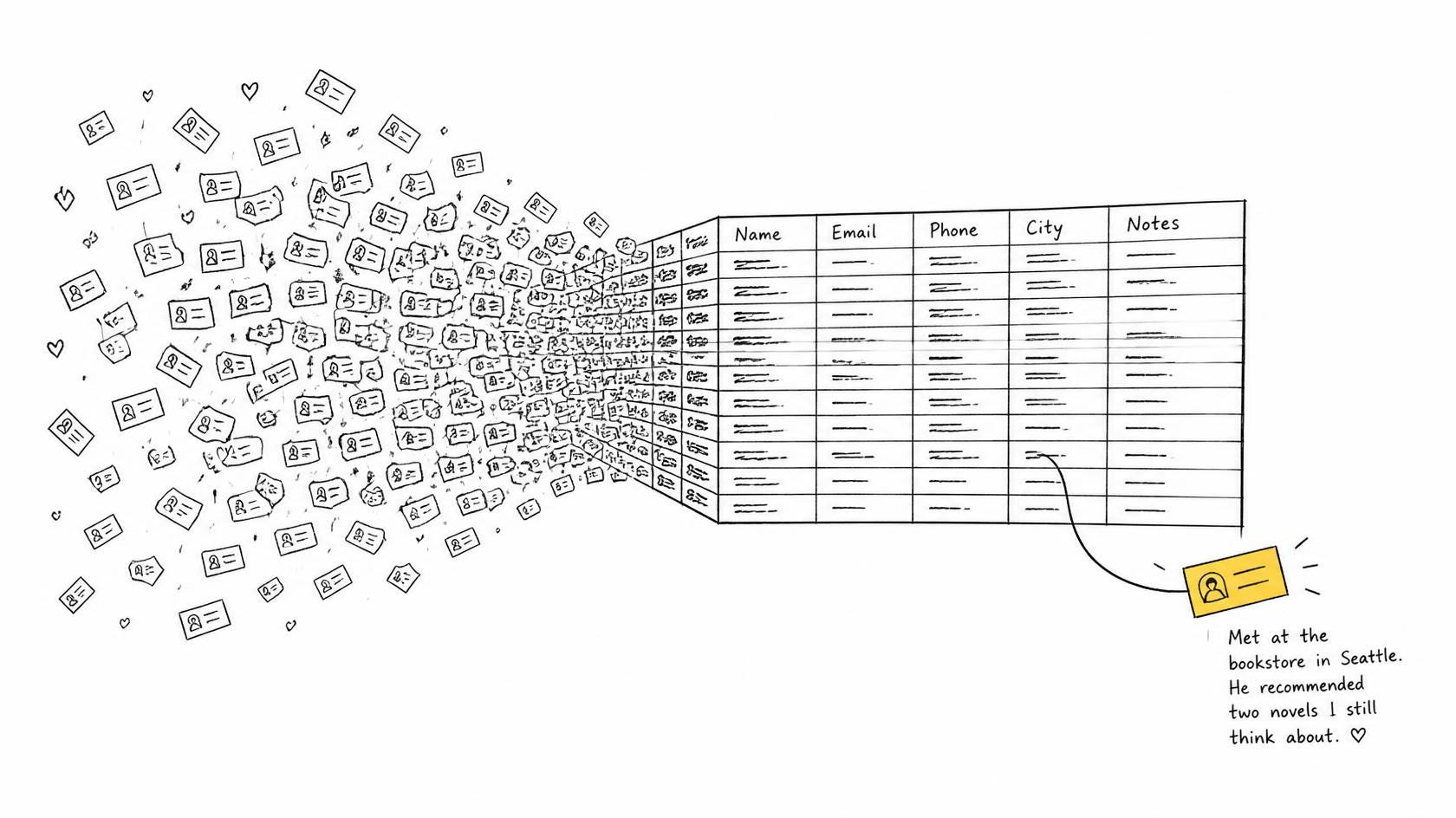
When 2,000 Connections Become a Spreadsheet
A large network creates a practical problem: LinkedIn was built for browsing profiles, not auditing several thousand relationships.
If your first-degree network is small enough, review it manually. Once the list becomes annoying to inspect, export your LinkedIn connections and work with the data in a spreadsheet. Sort by current company, job title, location, previous employer, and whatever field helps you remember how you know the person.
The spreadsheet will probably be messy. Job titles will be inconsistent. Companies will have changed names. Many rows will trigger absolutely no memory. This work is dull, and that is one reason people prefer editing a resume again.
AI can help rank the list, with a privacy caveat.
Remove personal email addresses before uploading connection data to a public AI service. Then describe your target role and ask the system to identify contacts who appear relevant based on company, title, location, or career path. Ask it to explain each suggestion so you can reject weak matches quickly.
Review every recommendation yourself.
The model does not know that you worked closely with one person for three years. It also does not know that another contact met you once at an event, that a third person never replied to your messages, or that a relationship ended badly. Those facts are often more important than the job title sitting in column D.
AI can reduce sorting time. Human memory still decides who belongs on the shortlist.
There is an odd side effect here. Exporting a network turns something that feels social into rows and cells, and you may notice how much of your LinkedIn network has become administrative clutter. I am not sure what the right network size is, or whether such a number even makes sense. A person with 300 relevant professional relationships may have far more useful access than someone with 12,000 loose connections.
Leave that question unresolved for now. You only need ten names.
Five Messages This Week
Pick ten people from your review.
Contact five this week. Keep the other five as the next group if the first set produces little response or points you toward a different part of the market.
Do not send the same message to everybody. The basic shape can remain similar, but the reason for contacting each person should be specific enough that they can see why you chose them.
One message might refer to a company. Another may mention a career change they made. A former manager needs very little explanation because the shared history already does most of the work.
Then track what comes back.
You are looking for information that changes behavior: a company to add, an employer to remove, a title you should search, a skill appearing repeatedly, a compensation assumption that seems wrong, or a hiring process you should prepare for differently. If five conversations produce the same warning, pay attention. If one person gives a dramatic opinion that nobody else supports, keep it in proportion.
A 2015 NBER paper by Amanda Pallais and Emily Glassberg Sands used three field experiments in an online labor market and found that referrals contained information about worker performance and persistence beyond observable worker characteristics. Referred workers were more likely to be hired, all else equal. The study does not show that you should ask every contact for a referral. It helps explain why employers may treat a credible recommendation differently from another application arriving without extra information.
Your first conversation may eventually produce a referral. Another may tell you that the company you were excited about has frozen hiring. A third may tell you that your target role now expects experience you do not have. That can feel like a poor return compared with submitting another application.
It may save you two weeks.
Job boards remain useful. You should still apply for relevant roles, and some people will get hired through applications without any prior relationship. The sequence is what deserves more attention. A few conversations at the beginning of a search can change what you apply for, how you describe yourself, and which assumptions deserve another look.
Start with five messages. See what people actually tell you, including the parts you did not want to hear, and decide what to change after that.
This section gives you a specific method for turning a LinkedIn export into a great contact list, deciding whom to message first, and handling the conversation without turning it into an immediate referral request.
The Contact Job Search Worksheet and Message Plan
The hardest part of reviewing a large network is deciding what “relevant” means before you start sorting. If you skip that decision, every familiar name looks promising.
