


You’ve read the advice: “The hidden job market, the networking, the ‘80% of roles are never posted.’” Fine, we all know that this is nonsense debunked 100 times. Now name three places to look tonight, at 9 pm, in your pajamas, with a laptop and no contacts. That’s where the advice stops, every time, and I think it stops because most of the people giving it haven’t looked for a job in a decade.
I coach job seekers on weekends. Not as a side hustle exactly, more like a habit I can’t shake after twenty years of recruiting. And the single most common thing I see is a person who has applied to 180 jobs on two websites and concluded they’re unhirable. They’re not unhirable. They’re standing in the busiest queue in the building, next to eleven hundred other people, wondering why nobody’s making eye contact.
The 70/80 percent nobody can source
Let’s kill something first.
The claim that 70 or 80 percent of jobs (I even heard 90 percent) are never advertised gets repeated everywhere, and I’ve never found a study behind it that holds up. It seems to trace back through decades of career-book folklore, Richard Bolles included, and every modern citation I chase ends up pointing at another article that points at another article.
I’ve spent an embarrassing amount of time on this and come up empty. So when I use the idea, I use it loosely: a lot of hiring happens through channels you can’t see from a search box. Not 70 percent. I don’t know the number and neither does the person quoting it at you.
What we do have is better and older. Mark Granovetter surveyed professional and technical workers in Newton, Massachusetts, in the late 1960s, and found that among those who got their job through a personal contact, only about 16 percent saw that contact often. The majority heard about the role from someone they saw occasionally or rarely. Acquaintances. The guy from your old team two jobs ago. The person you met once at a meetup and never spoke to again.
That study is over fifty years old, and the obvious complaint is that the world changed. So LinkedIn tested it at scale. Rajkumar and colleagues ran multi-year randomized experiments through the People You May Know algorithm, published in Science in 2022, covering something like 20 million users, and found that moderately weak ties produced more job mobility than strong ones. Not the weakest ties, which is the part everyone misquotes. The middle band.
Which tells you something useful about where to spend your evenings. Not on the big boards, where you are one of many. Not on your five closest friends, who already know everything you know. Somewhere in between, in places small enough that a real human reads what you send.

Greenhouse, Lever, and the postings that never syndicate
Here’s the least glamorous, highest-return thing you can do, and almost nobody does it because they think it's a time-wasting activity. I do not think that. Build a list of companies and check their career pages directly.
The reason this works isn’t mystical. Most mid-size companies run an applicant tracking system. Greenhouse, Lever, Ashby, SmartRecruiters, Workable, Personio if they’re European. Whether a job from that system ends up on Indeed depends on a syndication setting, a budget decision, or whether someone remembered to tick a box.
Roles get posted internally, and many companies post them publicly, but some can be turned off before an aggregator’s (like Indeed) crawl even catches up. I know several companies that open roles and close them on their own careers page before they show up anywhere else because they got dozens of good candidates. This is not a strategy, but a way to limit the talent pool and not pay crazy money for LinkedIn or Indeed job postings or adverts.
Applying through the company’s own page also drops you into a smaller pile. On a public aggregator listing, a Vienna engineering role might pull 400 applications in a week, most of them from people who applied to sixty things that afternoon. The same role through the careers page gets a fraction of that, and the people who found it that way have obviously done something deliberate. Recruiters notice source. We look at it. It’s one of the few signals in the pile that isn’t noise.
The catch is that you need a list. Which is boring work, and it’s why people skip it. More on that in a minute.
If you want somewhere to start on the board side, I keep a running list of global job search sites.
Niche boards deserve a sentence, not a section: if your field has a professional association, a trade publication, or a well-known conference, each of those probably has a job board nobody scrapes. Design has its own. Nonprofits have theirs.
Academic and research roles live almost entirely outside the aggregators. Go find yours. It took me four minutes to find the one for my field and I’ve never seen it syndicated anywhere.

Small rooms
The best hire I ever made came from a Slack group, and I wasn’t even recruiting in it. I was lurking because I wanted to understand what our engineers complained about. Someone posted a thread about a migration that had gone badly at their company, walked through what they’d tried, and got politely torn apart by three other members. His replies were better than his original post. I messaged him. Several months later he started with the company I worked for.
His situation was unusual, though. He wasn’t looking. He posted because he was annoyed, not because he wanted a job, and that’s exactly why it worked, which makes it hard to copy on purpose. I’ve also watched people join twelve Slack communities, post “hi everyone, open to work!” in each one, and get nothing. Because that’s an advert, and everyone in a small room can smell an advert.
Communities that actually produce work, in my experience: language and tooling Slacks, regional tech groups, subreddits for a profession rather than for job hunting, and the alumni Slack of a bootcamp or a former employer. Discord has them too. That last one is underrated and deserves its own article.
The rule of these rooms, if you want one: be useful for three or four weeks before you’re needy. Answer questions, share a thing you learned. Complain, specifically, about a real technical or operational problem. Then, when a #jobs channel post appears, you’re a name people recognise rather than a stranger.
That’s slow. Which is the cost, and I’m not going to pretend otherwise. If you need a job in three weeks, this is the wrong channel, and you should be doing the boring list thing instead.

Most people quit somewhere around company nine
Build a list of 40 to 60 companies. Not jobs, but companies.
How you build it matters less than that you build it. Look at who your last three employers competed with. Look at who sponsors your industry’s events. Look at the customer logos on the websites of vendors you’ve used. Look at who your former colleagues went to work for, which is the single fastest method and takes about twenty minutes on LinkedIn without needing to message anyone.
Then check each careers page every week or two. Bookmark folder, Sunday evening, forty minutes. That’s the whole thing.
People quit around company nine. I’ve watched it happen enough times to expect it. What it looks like in practice: you do fifteen on the first night with real energy, get to twenty-two the next day, and then on day three you open a careers page that hasn’t changed, then another that hasn’t changed, and something in your brain files the entire activity under pointless. The unchanged pages are the point. You’re not looking for a hit every time. You’re building a fast, cheap check on sixty organisations so that when something does open, you’re there in the first 48 hours instead of the third week.
Also, some of these companies will have a bad careers page. Broken filters, “no current openings” on a site that’s clearly stale. Note it and move on.
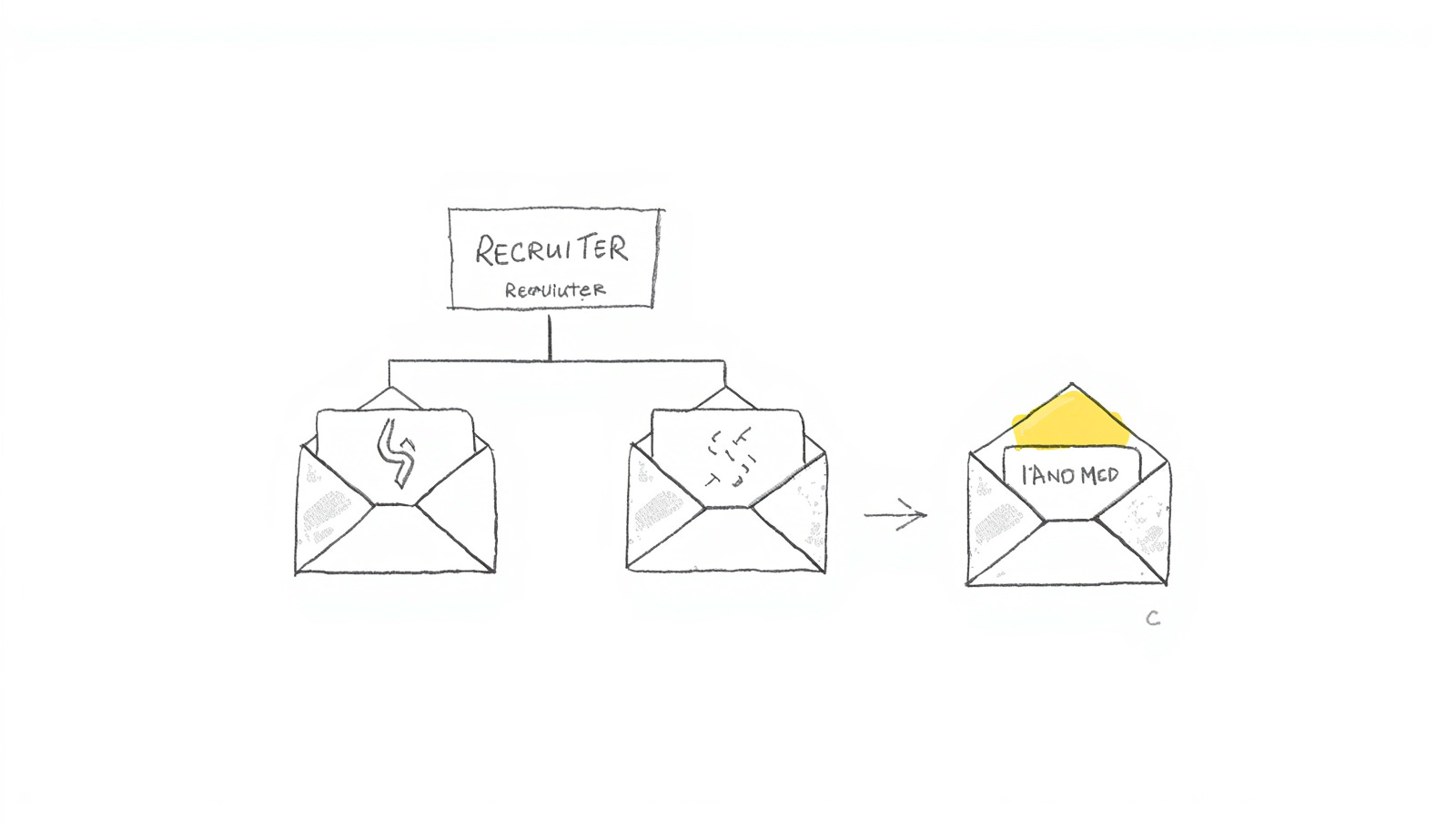
Most Outreach Gets Ignored
Direct outreach works; that's a fact. It also fails constantly, and anyone who tells you their message template gets a 40 percent reply rate is either lying or emailing twelve people and half of them are their family members.
My own numbers, when I’ve job-hunted (but it has been a while), were nothing special. I’d guess one reply in six or seven, and half of those replies were polite nothing. I also have data from clients I’ve coached. Initially, their success rate was 1 in 15-20 outreach attempts. After working together on new templates and more targeted outreach strategies, we were able to improve that rate to 1 in every 7 to 10 outreach attempts.
What I’ve learned, mostly from being on the receiving end of a few thousand of these: don’t send it to the recruiter. Send it to the person who’d be your manager, or their manager, and make it about a problem rather than about you. Two hundred words maximum. Reference something specific and recent, a product change, a talk they gave, a job ad they wrote badly. And ask for one thing, not for “a chat.”
Anyway. If you do one thing after reading this, make the company list. 50-60 names in a document. You can do it badly and it’ll still beat another evening of scrolling.
The exact search strings I use to find unlisted roles
Keep in mind that this guide focuses on Google, but don’t sleep on Bing. You might be surprised by the different results you get!
Here’s how to get started:
