


You can have solid experience, real skills, and a career you are proud of, yet still get no calls no interviews. That gap feels personal, but most of the time it has nothing to do with your value. It comes down to something much simpler. People cannot reach out to you if they cannot find you.
LinkedIn is a search engine first and a social platform second. Recruiters type in job titles, skills, tools, and locations. The system scans profiles for relevance. If yours does not contain the right signals, it gets pushed so far down the results that nobody ever sees it.
Many job seekers think their experience is the problem when the real issue is visibility. The platform cannot match you to the roles you fit or show your profile to a recruiter, because it does not have enough information to work with.
There is one frustration I hear all the time. People say they get profile views only when they apply for roles, never from recruiter searches. That is usually a sign that your profile is invisible, not weak. It means the system does not know who you are or what you do.
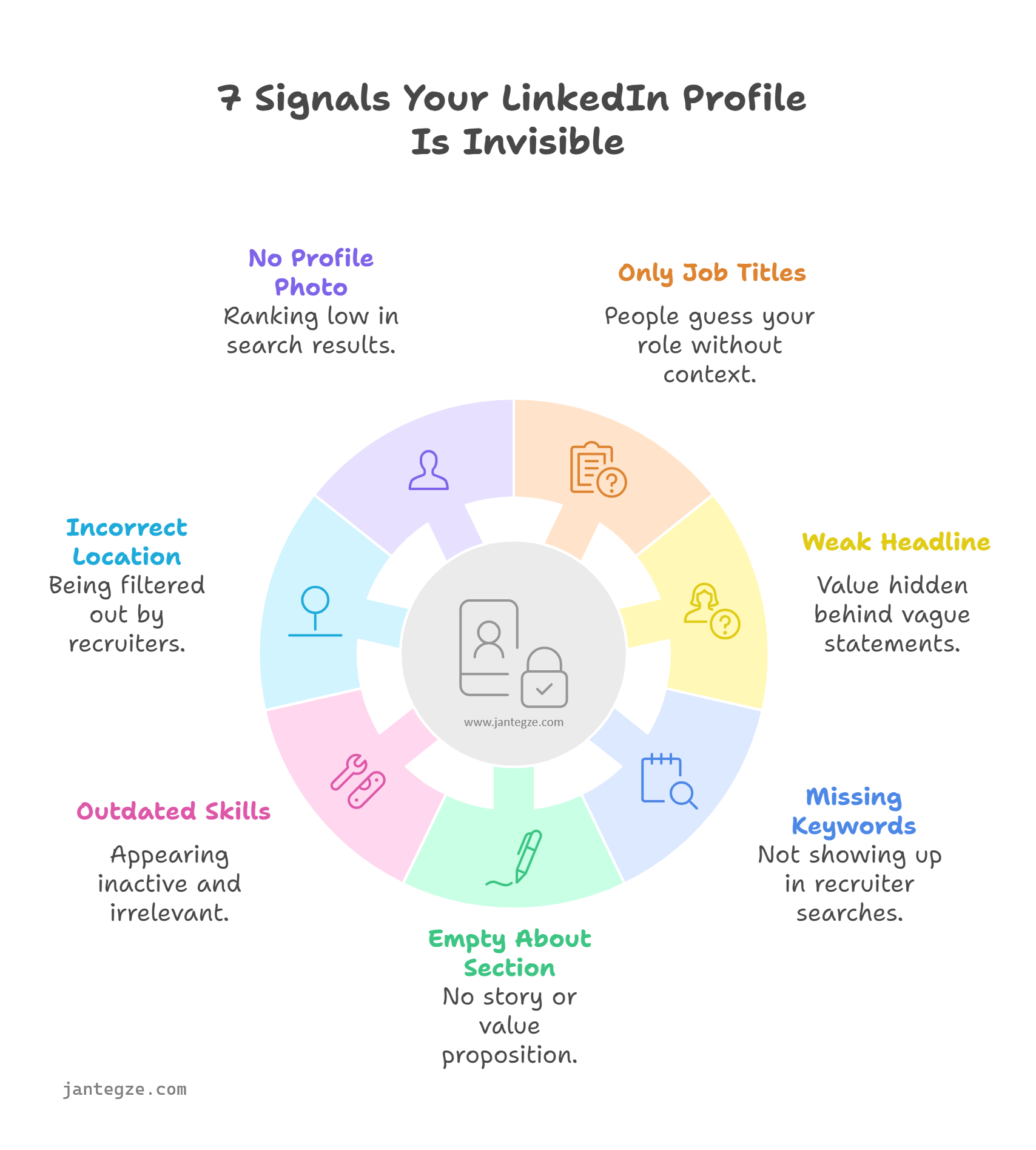
Here is what I cover next. The key signals that tell you your LinkedIn profile is hidden in search and how you can bring it back into view.
Why Visibility Matters More Than You Think
Most people assume recruiters scroll through the feed or check their network when they look for talent. That is not how it works. Almost every search begins in LinkedIn Recruiter, which relies on filters, keywords, and other information. If your profile does not match those signals, you never appear in the first few pages of results.
This means your visibility is shaped less by your experience and more by how clearly the system can read your profile. A strong background helps only if the algorithm can connect your skills to the terms recruiters type.
Here is the part most job seekers miss. LinkedIn is not guessing. It is trying to interpret patterns. It scans your headline, About section, skills, job descriptions, and even location. If these fields are thin or unclear, the system cannot match you to real hiring needs.
The problem gets worse when many profiles look the same on the surface. Recruiters often see hundreds of identical job titles, so the algorithm leans heavily on details. Profiles that provide context rank higher because they match real search queries with more accuracy.
The truth is simple. Visibility often matters more than polish. A profile that clearly explains your work will appear in far more searches than a profile that looks clean but says very little.
This is why so many skilled people stay hidden. Not because they lack ability, but because the system does not have enough signals to understand them. In the next parts of this article, you will see one of the biggest reasons this happens.
1. Only Job Titles, No Context
A job title without context is one of the quickest ways to become invisible. The system and the recruiter see the title, but they have no idea what you actually did. Two people can share the same title and perform completely different work. One might lead projects, another might handle support tasks. Without details, LinkedIn cannot tell the difference.
Your title is only the starting point. What matters is the story behind it. When your Experience section has no description, the algorithm has nothing to match to real searches. Recruiters look for skills, tools, responsibilities, and impact. If those elements are missing, your profile slips past their search filters.
Think of it from the recruiter’s perspective. They search for someone who used a specific tool, managed a certain process, or delivered a measurable result. If your profile only lists titles, you force them to guess whether you fit the job. Most never guess. They move on.
Here is what helps you stand out:
• A short list of your core responsibilities.
• The main tools or platforms you used.
• One or two results written in a simple XYZ format, such as I did X, measured by Y, using Z.
This does not need to be long. It only needs to be clear. When you add even a few lines of context, you give the search system the information it needs to place you in front of the right people. In this article, I’ll share a few tips on how to make your LinkedIn profile stand out.
Many job seekers overlook this part because they think a clean profile looks more professional. In reality, a clean profile with no substance makes you almost impossible to find.
2. A Weak or Vague Headline
Your headline is one of the strongest signals LinkedIn uses to rank your profile. Many people treat it like a place for slogans or clever lines, but the algorithm cannot interpret creativity. It can only interpret clarity.
When your headline says things like “Helping Companies Grow” or “Passionate About Innovation”, it gives the system nothing useful. Recruiters do not search for passion or clever slogans. They search for job titles, skills, and specialties. If your headline does not include these, your profile drops in relevance before anyone even clicks it.
If recruiters cannot understand your headline or skills, the algorithm cannot either. Visibility starts with clarity.
A weak headline also hurts you with humans. When a recruiter scans a list of results, they look for fast answers. They want to know what you do and who you help. If your headline feels vague or poetic, they assume your profile will be the same.
A strong LinkedIn headline has three parts.
• Your role or target role.
• One or two areas of focus.
• Optional context such as industry or skill type.
For example, instead of Product Specialist, try Product Specialist in SaaS and Customer Operations. It is simple, clear, and aligns with real search behavior.
This small change can move your profile from a broad, low relevance group to a focused, high relevance match. The difference is often noticeable within days because the system can finally place you in the correct search categories.
Most people underestimate the power of this one line. It shapes how the algorithm reads your entire profile.
3. Missing Role Keywords And Skills
Recruiters almost always start their search with keywords. They type in job titles, tools, certifications, and skill terms that match the role they need to fill. If your profile does not contain those same words, the system does not surface you, even if you are a perfect match.
This is where many people slip out of sight. They assume LinkedIn can infer their skills from their job titles, but the system cannot read between the lines. It looks for specific terms. If those terms do not appear in your profile, you drop in search ranking before a human ever sees you.
You might have the right experience, but without matching language, the system treats your profile as unrelated. For example, a data analyst who never mentions SQL or dashboards may never show up in searches for data roles. A project manager who forgets to list common tools might rank below people with half the experience.
Adding keywords is not about stuffing your profile with buzzwords. It is about speaking the same language recruiters use.
Here are a few areas where keywords matter most:
• Your headline.
• The first lines of your About section.
• Your skills list.
• Your Experience bullets, especially tools and methods.
Think of keywords as signposts. They help the algorithm understand your background and match you to real hiring needs. When these signposts are missing, the system cannot connect you to the roles you fit.
Once you fix this, you often see a quick rise in profile impressions because your profile finally appears in the searches where you belonged all along.
Most people get no calls because their profile is invisible, not because their experience is weak. Small fixes can change everything.
4. An Empty About Section That Says Nothing
Your About section is the one place where you can speak directly to the reader. It is also one of the most important places for the algorithm to understand your profile. When this section is blank or filled with generic lines, you lose both human attention and search relevance.
Recruiters use the About section to confirm what you actually do. They look for a quick summary of your strengths, the problems you solve, and the areas where you work best. When they scroll down and see nothing, they move on because they still do not know who you are.
The system has the same problem. A blank “About section” signals that your profile might be incomplete or inactive. That lowers your ranking, especially when competing with profiles that offer clear, readable information.
You do not need a long story. A short, honest summary works better. Aim for a few points.
• What you do in simple terms.
• What you enjoy working on.
• What types of problems you solve.
• Any key skills or tools that define your work.
Adding one or two small examples can help a recruiter understand your style and approach. If you helped speed up a process, improved a workflow, or supported a team through a tough project, a single sentence about it can make your profile feel real and current.
This section is your chance to give context that does not fit into job bullets. It helps people see your direction, not just your history. When the About section is missing, the platform fills that gap by ranking you lower.
5. Missing Or Outdated Skills
Your skills list is more important than most people think. Recruiters filter by skills all the time, and LinkedIn uses these signals to understand what kind of roles you fit. When your skills are outdated or incomplete, the system may treat your profile as inactive or irrelevant, even when you are actively looking for work.
This happens often. Someone updates their headline and About section, but they never touch the skills list. The algorithm sees a profile that looks unfinished. It has no proof that you work with current tools or methods, so it pushes your profile down in search ranking.
Another problem comes up when people keep old skills that no longer match their path. This makes your profile confusing. The system sees mixed signals, and that can lower your relevance score. Human readers get confused too, because your profile does not tell a clear story.
A strong skills list does a few things.
• It helps recruiters filter for your experience.
• It gives the system clear language to match you to jobs.
• It shows that you are active and keeping your profile current.
You do not need a hundred skills. A focused list of accurate, up to date skills works better. Add the tools you use now, not the ones you used eight years ago. If you earn a certification or pick up a new responsibility, update your skills right away.
Refreshing your skills once a year is a simple way to stay visible. It sends a signal that your profile is alive and relevant, which moves you higher in search and gives you a better chance of being found.

6. No Location Or The Wrong Location
Location is one of the strongest filters in recruiter search. Most searches begin with a city or region because companies need people who can work in a certain area. When your profile has no location or an incorrect one, you fall out of nearly every search that relies on that filter.
Many people remove their location because they want remote work. The intention makes sense, but the system reads it differently. A missing location looks incomplete. It reduces trust and lowers your search relevance. Even remote roles still lean on location data to group candidates by region or time zone.
A wrong location causes similar issues. If you list a city where you no longer live, recruiters in your actual area never find you. At the same time, recruiters in the listed location may skip you once they realize you are not there.
A clear, accurate location helps both humans and the algorithm.
• Recruiters know where you are.
• You appear in region based searches.
• Your profile looks complete and active.
This field carries far more weight than most people expect. It shapes your visibility in several behind the scenes filters, from local talent pools to role relevance scoring. A simple update can lift your profile into search results that were previously out of reach.
Profiles that combine the correct location with clear skills, context, and updated sections tend to show a steady rise in impressions because the system finally understands where to place them.
7. No Photo Or A Low Quality Photo
A profile without a photo is treated as incomplete. The system places more trust in profiles that look real and current, so a missing photo lowers your visibility before anyone reads a single line of text. Recruiters also filter by completeness because it saves time. Without a photo, you fall to the bottom of those lists.
Humans react the same way. People scan search results fast. A clear, simple photo signals that your account belongs to an active professional. A missing or blurry image signals uncertainty. Most recruiters skip profiles that feel unfinished because they have hundreds of candidates to review.
A good LinkedIn profile photo does not require professional lighting or a studio. A neutral background, soft light, and a natural expression are enough. You only need something that shows your face clearly and looks current. Your goal is not to impress, your goal is to look like a real person who is available and engaged.
The difference is often noticeable. A clean image increases trust, and trust increases clicks. More clicks send positive signals to the system, which helps your profile appear in more searches over time.
Visibility depends on clarity. A simple photo is one of the easiest ways to strengthen that signal.

What Changes First When Your Profile Becomes Visible
Visibility does not shift all at once. It rises in small steps, and those steps show up before any recruiter messages arrive. The first sign is a steady increase in profile impressions. This happens because your profile starts matching more searches. The system finally understands who you are and where to place you.
The next change is the pattern of views. You start seeing visits from people with job titles like recruiter, sourcer, hiring manager, or talent partner. They may not reach out yet, but they are finding you without you applying for anything. This is a strong signal that your headline, skills, and context are working.
Another early change is the click through rate on your profile. When your headline and About section answer the basic question of what you do, more people choose to open your profile instead of scrolling past it. That small improvement creates a feedback effect because higher engagement boosts your relevance in future searches.
You may also notice that suggested connections and job recommendations feel more accurate. The system uses similar signals to match content, profiles, and opportunities. When your data is clear, those suggestions align more closely with your actual background.
These small shifts create momentum. The more the system understands you, the more visible you become. This is often the turning point where job seekers move from silence to steady interest because their profile finally speaks the same language the platform is trying to read.
Improving visibility is not about creating a perfect profile. It is about removing the small barriers that keep the system from understanding your work. When your experience is clear and your details are current, both humans and the algorithm can place you in the right searches.
A good profile does not overwhelm people. It gives them enough information to decide quickly. That means simple headlines, short examples of impact, accurate skills, and a story that reflects your real strengths. These elements help you show up where opportunities live.
You do not need to reinvent your personal brand. You only need to present your work in a way that matches how people search. A few small changes create space for better conversations, more profile views, and more chances to speak with the right companies.
The next step is consistency. Refresh your skills once a year. Update your headline when your focus shifts. Add small wins when they happen. These habits keep your profile active, which raises your visibility over time.
Clarity builds momentum. Once your profile starts showing up in searches, you move closer to real opportunities without needing to chase every role. Visibility is not the final goal, but it is the part that makes everything else possible.
The Hidden Signals That Push You Higher In Recruiter Search
Some profiles rise in search even when they look simple on the surface. It has nothing to do with long paragraphs or flashy language. It comes from a few hidden signals that the system reads quietly in the background. These signals shape how your profile is ranked long before a recruiter ever sees your name.
