


A candidate once replied to a rejection email less than a day after applying and asked whether anyone had actually read the resume.
It was a fair question. The rejection had arrived quickly enough to feel insulting.
I remember the morning because I was eating a dry supermarket croissant over my keyboard, one meeting-room screen refused to connect, and I was supposed to be fixing a spreadsheet that had somehow turned every date into January 1900. By the time the candidate wrote back, the resume had been reviewed by a recruiter, discussed with the hiring manager, and checked with another person on the team.
Three people had looked at it.
The decision was still no.
Many job seekers assume a serious review must take several days. A rejection after two weeks feels painful, but somehow believable. A rejection after several hours feels like proof that nobody paid attention.
That assumption is often wrong.
A hiring team can review your application carefully, involve more than one person, and reach a decision within 24 hours. Speed can mean the team knew what it needed, communicated quickly, and did not leave you waiting while the answer sat in somebody’s inbox.
It can also mean the decision was too quick, biased, or simply mistaken. I have seen that happen too. Time alone tells you very little.
The 24-hour suspicion
People often use visible effort as a substitute for judging quality.
In a 2004 study, Justin Kruger and his colleagues told participants that a poem took either four hours or 18 hours to write. The people who believed it took longer rated it more highly. Similar experiments with a painting and a suit of armor found the same general pattern: when quality was hard to judge, people treated more effort as evidence of better work.
Hiring decisions are not poems, but the reaction is familiar. A candidate sees a quick rejection and imagines a recruiter glancing at the first line before clicking “reject.” A decision that takes a week feels more substantial because a week has passed.
The awkward part is that much of that week may contain no reviewing at all.
Your application might sit untouched for four days because the recruiter is interviewing and reviewing other candidates. The hiring manager may be traveling. A weekly intake meeting may have been moved. Someone may have forgotten to answer a Slack message. Then the team spends eight minutes discussing your resume on Friday and sends the rejection.
That feels like a five-day review. It was an eight-minute decision with four days of waiting around it.

The reverse happens as well. You apply at 8:00 am in the morning. A recruiter reviews the application at 9:20 am, sends it to the manager at 9:28 am, and gets an answer before lunch. Another team member checks one uncertain point in the afternoon. The rejection goes out at 2:15 pm.
You see several hours. The team sees a completed review.
Still, it captures something I hear from job seekers constantly: the belief that more elapsed time must mean more care.
It does not.

Your resume may have had three readers
Resume review is usually much narrower than candidates imagine.
The hiring team is not reading your resume to understand your entire career, assess every achievement, or decide whether you are generally talented. It is answering a smaller question: should we spend more time with this person for this specific position?
That can be answered quickly when the requirements are clear.
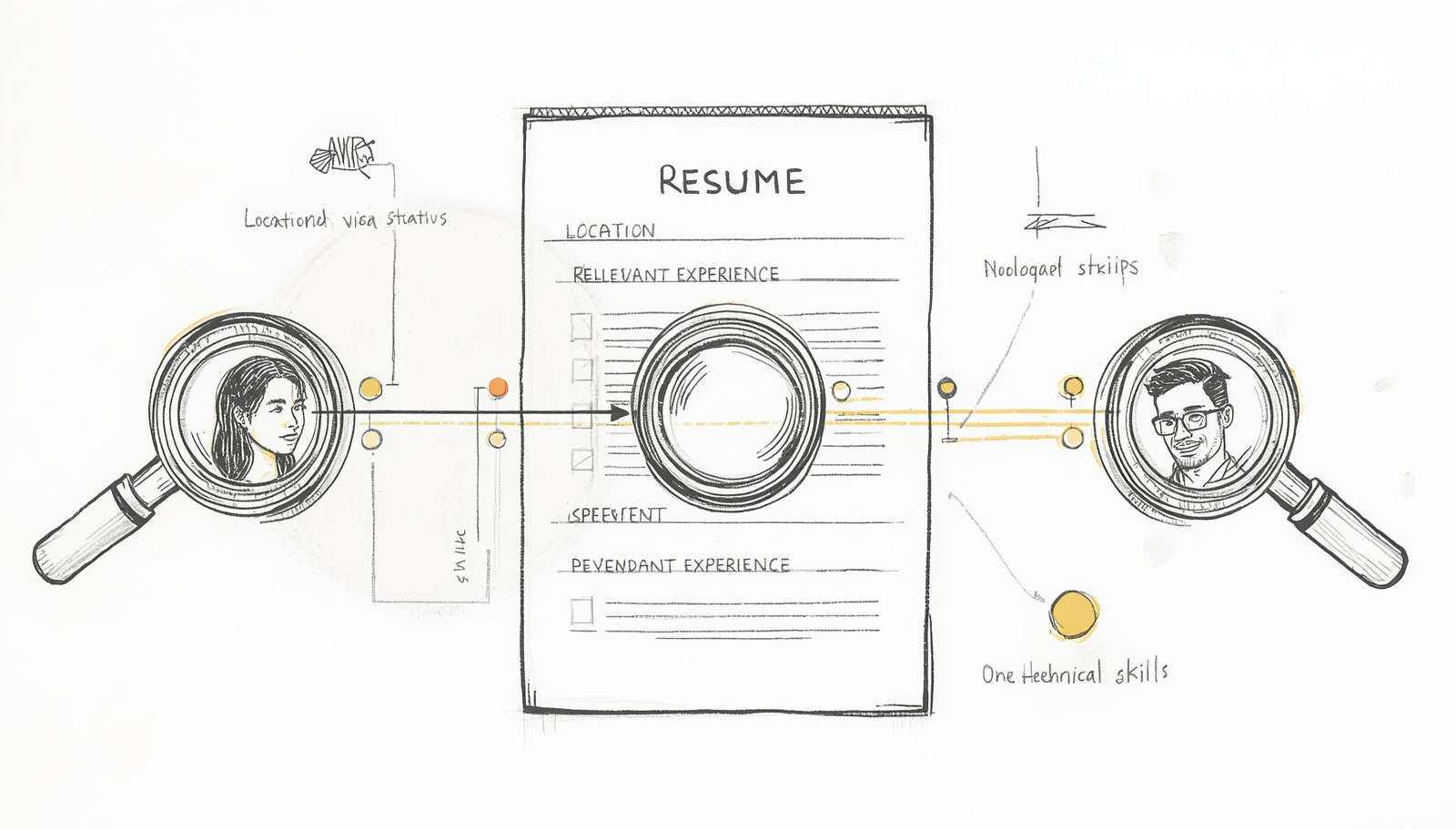
Suppose a role is based in Berlin, requires three office days each week, and cannot support relocation or visa sponsorship. A candidate living outside the country states that relocation and sponsorship are required. The work experience may be strong. The resume may be well written. None of that changes the operating limit attached to the role.
A recruiter can identify the issue in under a minute. The hiring manager may confirm that no exception is available. Legal or mobility may already have given the team a standing answer weeks earlier.
The rejection is quick because the answer is known, not because the candidate was ignored.
Level is another common example. A team may need someone who has already led production incident response, designed reliability practices, and coached other engineers. A resume showing one year of support experience is not going to become a lead-level match after 20 minutes of rereading.
I have still reread resumes like that longer than necessary, partly because rejecting people is unpleasant and partly because I wanted to find a reason to keep someone in consideration. That extra time rarely changed the evidence in front of me.
There is a whole separate discussion about whether employers write requirements too narrowly. I am not going into that here, although it is important to mention that some requirements are flexible, while others, like specific experience or knowledge, are not.
A quick review can also involve several short checks rather than one long reading. The recruiter confirms the basics. The manager looks at the relevant work. A technical lead answers a narrow question, perhaps whether a certain background could transfer into the team.
Each person may spend only a few minutes. Together, that is still a real review.
Recruiters are not starting from zero
An experienced recruiter does not open your resume as a blank page.
Before applications arrive, the recruiter has usually discussed the role with the manager, reviewed the job description, learned which requirements are flexible, and heard why previous candidates were rejected. After screening 10 or 20 people for the same position, the recurring patterns become obvious.
That does not make the recruiter infallible. It makes the task familiar.
The difference matters. Reading a resume for a known role is less like reading an essay and more like checking a document against a question you already understand. Is the person at roughly the right level? Is the needed experience visible? Are there location or authorization limits? Is there enough evidence to justify a conversation?
Research on resume evaluation supports the idea that recruiters form hiring recommendations through specific fit judgments rather than through a complete reading of a person’s history. A 2011 field study collected data from 216 organizational recruiters at seven universities in Taiwan. Work experience and education affected recommendations through the recruiters’ perception of fit with the job, while work experience also influenced perceived fit with the organization.
That study did not test whether faster decisions were better, and I do not want to stretch it into saying that. It does show that recruiters are extracting selected signals and using them to answer a fit question. They are not giving every sentence equal weight.
This is why a recruiter can spend more time on six lines from your current role than on the rest of the document. Those lines may contain the answer.
A job seeker once told me that a recruiter could not possibly understand ten years of experience in five minutes. She was right. The recruiter could not understand all ten years.
But the recruiter did not need to.
The role required recent experience managing a specific type of program across several countries. Her resume showed deep experience in one country and no sign of regional responsibility. Perhaps she had done it and left it out. Perhaps the company should have called to ask. The resume did not provide the evidence, and the first review was based on what was there.
That story only partly supports my argument. A fast decision may have been reasonable based on the document and still missed a qualified person.
Fast decisions can still be wrong
Speed should not be defended for its own sake. And I am not going to say that someone is right just because they make a decision quickly. That’s why many recruiters like me reach out to hiring managers for a second opinion on resumes when we are unsure.
A recruiter who scans for a familiar employer name, makes assumptions about a career gap, or rejects an unusual title without checking the work can make a bad decision very quickly. More time would not guarantee fairness, but a pause might expose the weak reasoning.
Several eye-tracking studies examined how recruiters looked at resumes and used that viewing data to predict whether a resume would move forward. Time spent on the experience and education sections mattered, as did total viewing time and moments when recruiters appeared to look away and reflect.
Studies like these are a useful correction to the popular claim that every recruiter makes a final decision in six seconds. Some initial scans are extremely brief. A full screening decision may take longer, especially when the match is uncertain.
Clear rejections are often quick. Clear advances can be quick too. The middle takes time.
I am less comfortable with rapid decisions when the criteria are vague. “Not quite the profile” is not a criterion. “I just don’t see it” is not much better. When the hiring manager cannot explain what evidence is missing, speed may be covering intuition rather than disciplined evaluation.
Decades of selection research also warn against treating a resume as a strong prediction of future performance. Schmidt and Hunter’s 1998 review of 85 years of research compared 19 selection methods and found stronger results from combinations involving work samples and structured interviews. A resume is an early filter, not a complete test of ability.
A recruiter can make a careful resume decision in ten minutes. That does not mean the resume decision deserves more authority than it has.
What to do after the quick rejection
Do not measure the quality of the review by the timestamp.
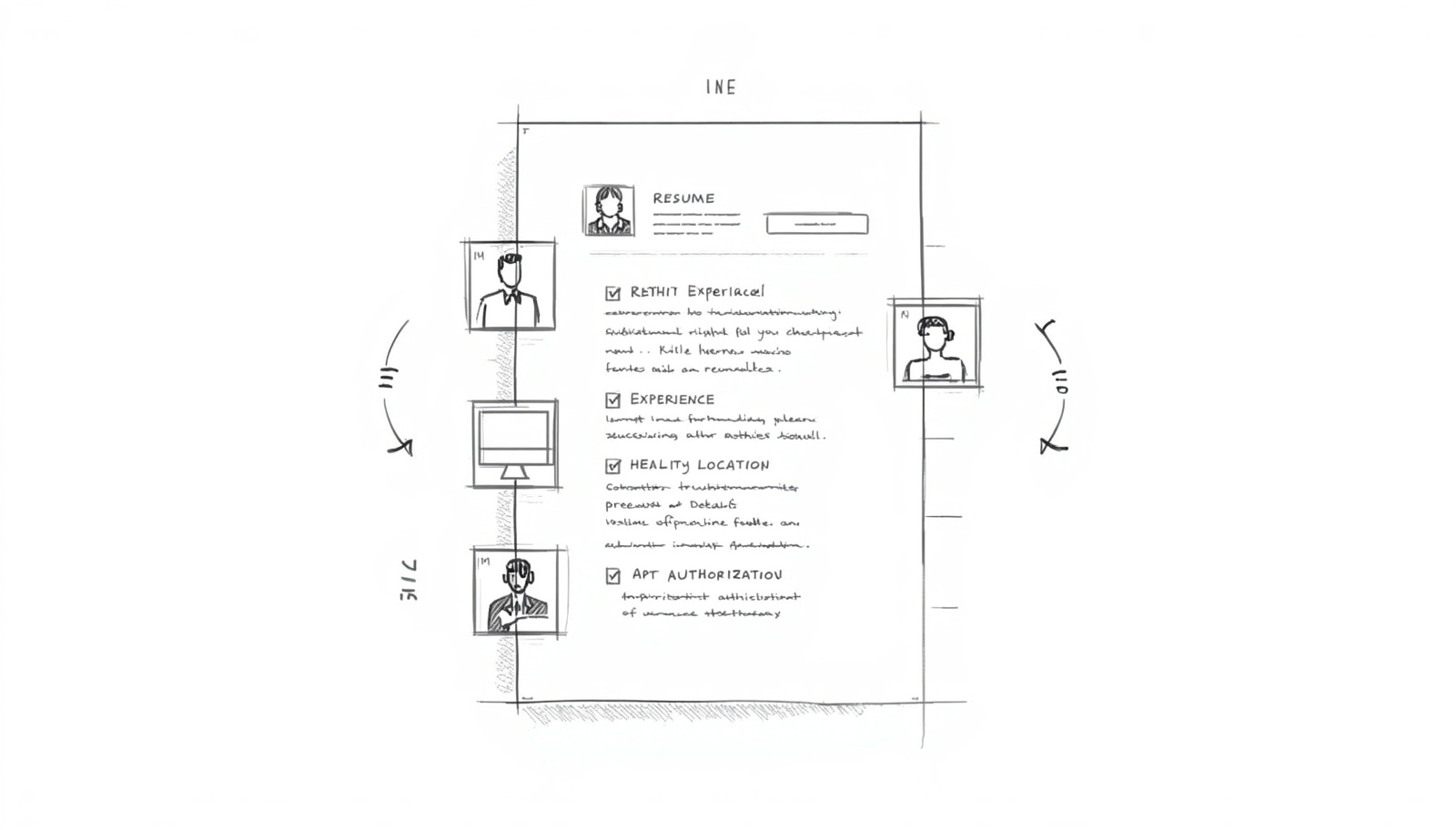
Look instead at whether your resume made the relevant facts easy to find. For many roles, two areas cause fast decisions: location and work authorization, then the recent experience connected to the job.
Put those facts where they cannot be missed.
If you already live in the required country and have unrestricted work authorization, state it plainly near your contact details when the vacancy suggests it may matter. Do not make the recruiter infer your status from a city name, a university, or the language used in your resume.
Then examine the first half of page one. Could someone who knows the vacancy find your current level and the most relevant experience without decoding internal job titles? If your title is unusual, add a short description. If the strongest matching work happened inside a broader role, bring that work forward.
This costs something. A resume written for one type of vacancy becomes less suitable for another, and rewriting it repeatedly is dull. Most people stop here. They keep one broad version because tailoring feels like unpaid administrative work, which is exactly what it is.
I do not tailor every line for every application either. I would focus on roles you genuinely want and fix the evidence that could decide the first review.
You may still receive a rejection within 24 hours.
When that happens, it is reasonable to feel disappointed. It is not reasonable to assume that the speed proves nobody looked. The team may have known the answer quickly, may have checked it with several people, and may have been wrong anyway.
Those possibilities can all exist together.
Next week, another recruiter may take six days to reach the same decision because the manager is on leave, and there may be no deeper meaning in that either.
The free article explained why eight elapsed hours can contain several real reviews. What it did not show was the work inside those hours. Below is a composite case, built from real hiring situations, showing the notes, questions, handoffs, and decision points behind one same-day rejection.
A Same-Day Resume Review, Minute by Minute
The vacancy is for a senior product security engineer.
The hiring manager needs someone who has worked directly with software engineering teams, reviewed application designs, run threat-modeling sessions, and helped developers fix security problems before release. General cybersecurity experience is useful, but it is not enough on its own.
The candidate applies at 8:47 on a Wednesday.
